








What's Happening?
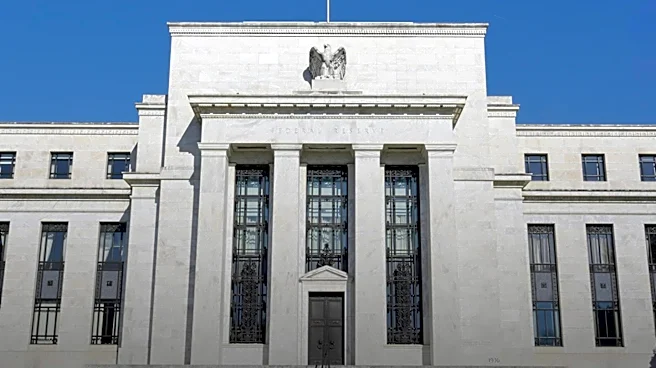
The Federal Reserve, through its Federal Open Market Committee (FOMC), decided on October 28, 2026, to keep the federal funds target range steady at 3.75% to 4.00%. This decision, which also maintained the interest rate paid on reserve balances at 3.90%,
was made with a 10-2 vote. Governor Lisa Cook and Beth Hammack, President of the Federal Reserve Bank of Cleveland, dissented, advocating for a 0.25-percentage-point rate increase. This announcement coincided with a busy week for Big Tech earnings, including reports from Microsoft, Alphabet, and Amazon. Alphabet's third-quarter results, which are public, showed earnings per share of $2.12 and revenue of $127.58 billion, falling short of analyst estimates of $3.01 EPS and $127.93 billion in revenue. The Fed's decision to hold rates was largely anticipated by markets, but the hawkish dissents suggest that a rate cut is not imminent.
Why It's Important?
The Federal Reserve's decision to hold interest rates at their current level has significant implications for the U.S. economy, particularly for the technology sector. Higher-for-longer interest rates mean that capital remains costly, directly impacting startup funding, hiring budgets, and cloud spending decisions for software developers and tech companies. This environment raises the bar for new tools and headcount, favoring companies with clear revenue streams over those relying on growth stories. For Big Tech, the cost of capital influences investment in areas like AI infrastructure. Alphabet's earnings miss, particularly the significant shortfall in earnings per share despite near-target revenue, highlights how investors are scrutinizing profitability alongside growth, especially in the context of substantial AI investments. The hawkish dissents within the FOMC signal that the Fed is prioritizing inflation control, which could lead to continued tight monetary policy and further pressure on tech valuations.
What's Next?
Given the hawkish dissents within the FOMC, a near-term rate cut appears unlikely, suggesting that the Federal Reserve will continue to monitor economic data before making further adjustments. This implies that borrowing costs for companies, mortgages, and credit lines will remain at current levels for the foreseeable future. For the tech sector, this means continued pressure on valuations, particularly for companies that prioritize growth over immediate profitability. Microsoft and Amazon's upcoming third-quarter results will be closely watched to see if they confirm a broader trend of strained profits in the Big Tech sector, especially concerning cloud growth and capital spending on AI. Software teams and engineering leaders are advised to audit cloud commitments, tie AI tool usage to measurable outcomes, and delay multi-year vendor lock-ins, as financial discipline will be paramount in this economic climate.
Beyond the Headlines
The Federal Reserve's sustained interest rates and the mixed performance of Big Tech earnings underscore a broader shift in investor sentiment and economic priorities. The era of cheap capital that fueled rapid, often unprofitable, growth in the tech sector appears to be over. Investors are now demanding clear paths to profitability and efficient capital allocation, particularly concerning massive investments in AI. This shift could lead to a consolidation among smaller software firms, as larger, cash-rich acquirers gain an advantage over startups struggling to secure funding. Furthermore, the increased scrutiny on AI spending and its return on investment could force tech companies to demonstrate tangible value from their AI initiatives, moving beyond mere enthusiasm. This environment fosters a return to financial discipline, potentially leading to more sustainable business models across the technology industry, even if it means a slower pace of innovation for some.