






What's Happening?
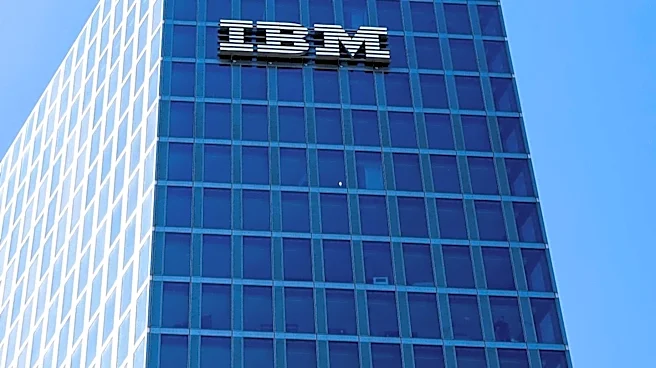
IBM Watson, an AI and machine learning platform developed by IBM, continues to be a significant player in the enterprise AI landscape. Initially gaining prominence after winning the American quiz show 'Jeopardy!' in 2011, Watson has since expanded its
functionalities to include natural language processing, image recognition, text-to-speech conversion, document search, and sentiment analysis. The platform is designed for enterprise-level customization, allowing businesses across various sectors like finance, healthcare, and manufacturing to integrate its AI capabilities into their operations. Recent reports highlight its application in 10 specific cases across seven different industries, demonstrating its versatility in automating tasks and managing data. While large corporations have historically invested substantial resources into Watson implementations, the platform's evolution suggests ongoing relevance in the AI market.
Why It's Important?
The continued development and application of IBM Watson are important for the U.S. business landscape as they showcase the ongoing demand for sophisticated AI solutions in enterprise environments. Watson's ability to be customized for diverse industries, from financial institutions seeking to standardize customer service responses to manufacturing companies using image recognition for quality control, illustrates the broad impact AI can have on operational efficiency and decision-making. The platform's focus on natural language processing and data management is particularly critical in an era of increasing data volume and the need for rapid, accurate information retrieval. The investment by major U.S. and international companies in Watson signifies a broader trend towards AI adoption to enhance productivity and maintain competitive advantage, influencing how businesses approach technological integration and workforce augmentation.
What's Next?
The future of IBM Watson will likely involve further refinement of its AI and machine learning capabilities, with a continued emphasis on enterprise-specific solutions. As the AI market evolves, IBM will need to adapt Watson to address emerging needs and integrate with newer AI paradigms, such as autonomous AI agents. While large-scale implementations of Watson have historically required significant financial and IT infrastructure investments, there may be a push towards more accessible and cost-effective deployment models to cater to a wider range of businesses, including small and medium-sized enterprises. The ongoing strategic adjustments by IBM, such as the divestiture of Watson Health in 2022, indicate a dynamic approach to its AI portfolio, suggesting that future developments will be guided by market demands and profitability considerations. Companies considering AI adoption will need to carefully evaluate the evolving capabilities and implementation costs of platforms like Watson.
Beyond the Headlines
Beyond its direct applications, IBM Watson's journey reflects broader shifts in the perception and implementation of AI. Its initial public success on 'Jeopardy!' set high expectations for general AI, but its subsequent evolution into a specialized enterprise platform highlights the practical realities of AI deployment—often requiring significant customization and integration into existing complex systems. This trajectory underscores the ethical and practical considerations of AI, particularly regarding the balance between automation and human oversight. The cases where Watson assists human operators rather than fully replacing them, such as in call centers or insurance claim processing, illustrate a growing understanding of AI's role as an augmentation tool. This approach raises questions about future workforce development, the need for specialized AI talent, and the ongoing challenge of making advanced AI technologies both powerful and accessible to a broader economic spectrum.