





What's Happening?
The metal business card engraving market is experiencing significant growth, with segments like metal and NFC cards expanding at 15-20% annually. This growth has led to an influx of new vendors, making it more complex for buyers to compare quotes fairly.
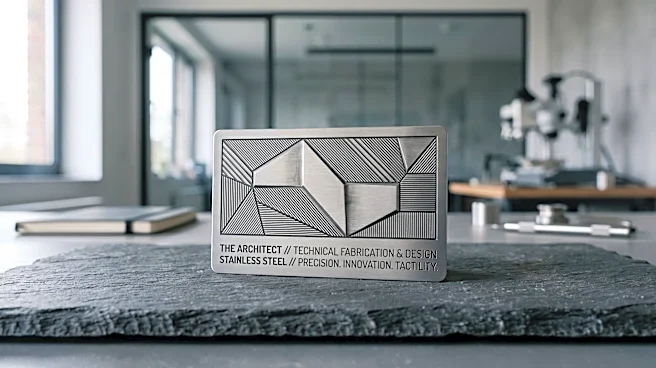
A key issue is the inconsistent terminology used by vendors; terms like 'engraving,' 'etching,' 'marking,' and 'annealing' are often used interchangeably despite describing distinct production methods with varying depths and contrast profiles. For instance, one vendor's 'engraved metal card' might refer to a deep-engraved stainless steel card with a 0.15 mm line depth, while another might describe a surface-annealed mark with minimal topographical alteration. This lack of standardization means buyers often compare prices for fundamentally different products. The global business card market is valued at approximately $3.8 billion, highlighting the scale of this industry. Buyers frequently focus solely on price per card, overlooking crucial details about what that price actually covers, leading to disappointing results. Understanding the core techniques, such as fiber laser systems for precise results on reflective metals and chemical etching for similar depth on stainless steel, is essential for informed decision-making.
Why It's Important?
The inconsistencies in vendor terminology and pricing structures have significant implications for businesses and professionals seeking high-quality metal business cards. Without a clear understanding of the different engraving methods and their associated costs, buyers risk overpaying for inferior products or receiving results that do not meet their expectations. This can impact brand perception, as business cards often serve as a tangible representation of a company's professionalism and quality. The rapid growth in the metal card segment indicates a rising demand for premium, durable business cards, making it crucial for buyers to navigate the market effectively. Businesses that fail to properly evaluate vendor quotes may incur unnecessary expenses, experience delays due to re-orders, and ultimately undermine their professional image. The market's complexity also creates an uneven playing field, where less scrupulous vendors can capitalize on buyer ignorance by offering seemingly lower prices for less robust or aesthetically pleasing products. Therefore, a standardized approach to comparing quotes is vital for ensuring fair competition and consumer protection within this growing niche.
What's Next?
To address the challenges in comparing metal business card engraving quotes, buyers are advised to adopt a systematic framework. This involves standardizing the engraving method before requesting quotes, ensuring all vendors are bidding on the same production technology. Buyers should also demand fully itemized quotes that detail unit card cost, setup fees, double-sided surcharges, color fill charges, rush fees, and shipping costs. Verifying design file requirements, such as vector formats, minimum line widths, and font sizes, is also crucial. Industry best practice suggests ordering a custom sample using actual artwork before committing to a full production run to assess quality aspects like depth consistency, edge sharpness, and finish uniformity. Furthermore, buyers should obtain written confirmation of lead times, remake policies for defects, and responsibility for return shipping. By calculating the total cost per card inclusive of all fees at their target quantity, buyers can make more informed decisions and avoid being misled by headline unit prices. This structured approach will help buyers navigate the complex market and secure products that align with their quality expectations and budget.
Beyond the Headlines
The challenges in the metal business card engraving market reflect broader issues of transparency and standardization in specialized manufacturing sectors. The lack of consistent terminology and detailed cost breakdowns can lead to information asymmetry, where vendors possess more knowledge than buyers, potentially leading to exploitative pricing or quality compromises. This situation highlights the need for industry-wide standards or consumer education initiatives to empower buyers. Ethically, vendors have a responsibility to clearly articulate their processes and pricing, fostering trust and fair competition. Legally, while specific regulations might not exist for business card engraving, general consumer protection laws could apply if vendors engage in deceptive practices. Culturally, the increasing demand for premium metal business cards signifies a shift towards tangible, high-quality branding elements in a digital age, where physical interactions still hold significant value. The longevity and tactile feel of metal cards offer a distinct advantage over traditional paper cards, making the investment worthwhile for many professionals, provided they can navigate the market effectively to ensure quality and value.