





What's Happening?
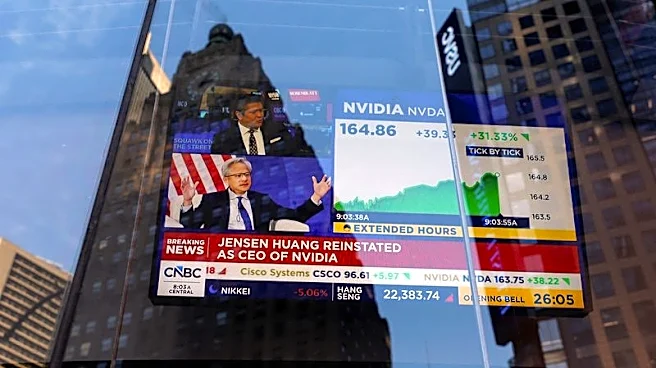
Nvidia's board has unanimously reinstated Jensen Huang as CEO and president, effective immediately, less than two weeks after his initial departure. This decision led to a significant surge in Nvidia's stock, which traded up 27.3% to $159.81 in early
trading, potentially adding approximately $828 billion to its market value. If this gain holds until the closing bell, it would surpass Microsoft's record for the largest single-day market capitalization increase. Huang's return follows a period of stock decline and a petition supporting his reinstatement, which garnered over 190,000 signatures. Despite his previous public statement acknowledging 'serious mistakes' in his personal life, the board reversed its earlier stance, which had indicated no intention of reinstating him. The company's strong financial performance continued even during his absence, with Q3 revenue reaching $115.8 billion, up 103.2% year-over-year, and adjusted EPS exceeding consensus estimates.
Why It's Important?
Jensen Huang's reinstatement as Nvidia's CEO is a pivotal event for the U.S. technology sector, particularly for the artificial intelligence (AI) industry. His leadership is widely seen as crucial for Nvidia's strategic direction and its relationships with key suppliers and partners, which are vital for the continued growth of AI infrastructure. The dramatic stock rebound underscores the market's confidence in Huang's ability to navigate the complex landscape of high-tech manufacturing and innovation. This event also highlights the significant influence of individual leaders in shaping the fortunes of major corporations and, by extension, entire technological ecosystems. For investors, it signals a potential stabilization and renewed growth trajectory for Nvidia, a company at the forefront of the AI revolution, impacting investment strategies across the tech market. The episode also raises questions about corporate governance and the balance between board decisions and shareholder sentiment.
What's Next?
Despite Huang's reinstatement, several challenges and events lie ahead for Nvidia. Huang is scheduled to appear before House lawmakers on December 1 to address national security questions, and the board's independent investigation remains open. These factors could introduce new uncertainties for the company. Nvidia's guidance currently assumes no Data Center compute revenue from China, indicating ongoing geopolitical considerations. The company also carries substantial guarantee exposure tied to customer data center projects, totaling up to $118 billion. Investors will closely monitor the outcome of the congressional hearing and the independent investigation for any new developments that could impact Nvidia's operations or stock performance. The market will also be watching to see if the stock can sustain its gains and if Huang's return can solidify supplier ties and ensure the timely launch of new products like the Vera Rubin NVL72 racks.
Beyond the Headlines
The reinstatement of Jensen Huang at Nvidia carries deeper implications beyond immediate stock market reactions. It highlights the increasing intersection of corporate leadership, national security, and government influence in the U.S. technology sector. The board's decision, reportedly influenced by 'senior levels of the United States government,' sets a precedent for potential White House involvement in the leadership of major public companies, raising questions about the boundaries of executive branch influence. This dynamic could reshape corporate governance practices, particularly for companies deemed critical to national interests or economic competitiveness. Furthermore, the episode underscores the intense scrutiny on technology exports and supply chain integrity, especially concerning China, reflecting broader geopolitical tensions. The resolution of these issues for Nvidia could serve as a template for how other U.S. tech giants navigate similar challenges, influencing long-term strategic planning and risk management in the industry.