






What's Happening?
The packaging industry is seeing significant innovation in plant-based materials to create more sustainable alternatives to traditional plastics. Manufacturers and researchers are focusing on overcoming performance limitations to enable wider adoption
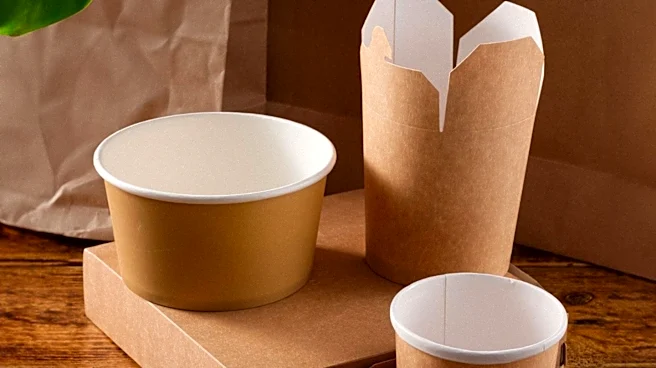
of these eco-friendly solutions. For instance, fibre-based packaging, made from renewable plant fibres, is receiving substantial investment. Companies like Metsä Board and Metpack have collaborated to develop home-compostable hot cups, while One.Five introduced Bluemorph, an 'ultra-high barrier' paper solution for challenging chilled and frozen food categories. Additionally, natural plant protein feedstocks are being utilized by companies like Xampla to create compostable and biodegradable materials for single-use plastic replacements. Research is also exploring cassava-based solutions, with projects from the University of the South Pacific (USP) developing edible and biodegradable food coatings from cassava starch, and a Nigerian startup, White Gold, creating compostable packaging materials from cassava to address plastic disposal issues.
Why It's Important?
This shift towards plant-based packaging is crucial for environmental sustainability, aiming to reduce plastic waste and its impact on ecosystems. The innovations address consumer demand for eco-friendly products, particularly within the plant-based food and beverage sector, where environmental footprint is a key purchasing driver. By developing materials that are recyclable, compostable, and biodegradable, these advancements contribute to a circular economy and mitigate pollution. The ability of new materials to perform on par with or even surpass traditional plastics in terms of strength, functionality, and product protection is vital for widespread adoption across various food categories, including sensitive products like grated cheese and frozen foods. This movement also fosters collaboration across the value chain, involving research institutes, packaging producers, and startups, which is essential for scaling up these technologies and bringing them to market.
What's Next?
The immediate future will likely see continued efforts to improve the performance and scalability of plant-based packaging solutions. Researchers, such as the USP team, are working on enhancing properties like water retention in cassava starch-based coatings to broaden their application. Industry players anticipate further innovation in materials and technologies, enabling fibre-based packaging to expand into more demanding applications. A key challenge remains the transition from lab-scale development to mass production, requiring specialized technical knowledge and significant financial investment. Startups like White Gold are actively seeking funders who understand their ecosystem and are patient with the development process. Continued collaboration across the value chain, involving research institutions, material suppliers, and packaging manufacturers, will be critical to driving momentum and achieving a more sustainable packaging future.
Beyond the Headlines
The deeper implications of this trend extend beyond mere material replacement. It signifies a fundamental rethinking of product design and consumption patterns, moving towards a more regenerative model. The focus on plant-based packaging highlights a growing ethical imperative within industries to minimize environmental harm and embrace circularity. This shift could lead to new agricultural demands for crops like cassava, potentially impacting local economies and land use. Furthermore, the development of edible packaging, as seen with Xampla's materials, could revolutionize how food is consumed and packaged, blurring the lines between product and container. The success of these innovations will depend not only on technological advancements but also on consumer acceptance, regulatory support, and the establishment of robust infrastructure for composting and recycling these novel materials, ultimately shaping a more sustainable future for packaging and consumption.