




What's Happening?
Zipline, a drone delivery company, has successfully raised an additional $1.5 billion in funding, bringing its post-investment valuation to $21.5 billion. This significant capital injection, led by Paradigm, WCM Investment Management, and Layer Global,
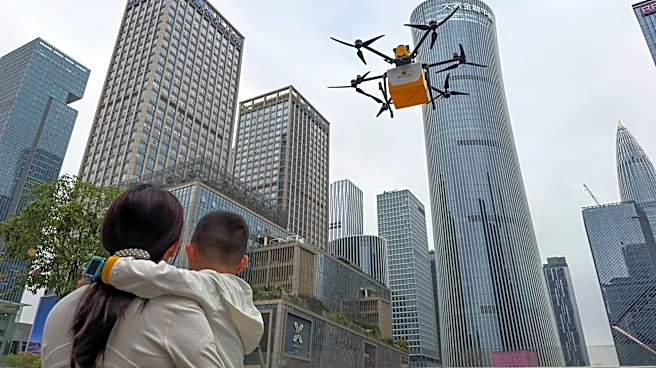
with participation from investors including Valor Equity Partners, Fidelity, Uber, Tiger Global, J.P. Morgan, ARK Invest, and Salesforce Ventures, is earmarked for a substantial expansion of its U.S. operations. The company plans to utilize these funds to scale up its manufacturing facilities, increase hiring, and establish a nationwide drone delivery network across the United States. This financing round follows a previous one in January that secured over $600 million at a $7.6 billion valuation, indicating a rapid increase in investor confidence and the company's perceived value within the private market. Zipline has reported flying 150 million commercial autonomous miles without a safety incident and completing over one million deliveries in the Dallas-Fort Worth region during 2026.
Why It's Important?
This substantial investment in Zipline underscores a growing belief in the viability and scalability of drone delivery services within the U.S. logistics landscape. The funding will enable Zipline to significantly accelerate its national expansion, potentially transforming last-mile delivery for various goods. For U.S. consumers, this could mean faster and more efficient delivery options, particularly in areas where traditional logistics face challenges. For businesses, especially major retailers like Walmart, which plans to add 300 sites under a national multi-year agreement with Zipline, and Uber, targeting one million deliveries a day with Zipline by 2029, this expansion offers a new avenue for fulfilling customer demand and optimizing supply chains. The increased competition and technological advancement in drone delivery could also drive innovation across the logistics sector, potentially leading to cost efficiencies and new service models. However, the company still needs to demonstrate profitable delivery volumes and sustainable unit economics to meet the high expectations set by its valuation.
What's Next?
Zipline intends to deploy the newly acquired capital to expand its U.S. manufacturing capabilities and increase its workforce, which are critical steps for building out a nationwide delivery network. While a detailed spending schedule or profitability timeline has not been disclosed, the company's focus will be on converting regulatory progress and existing retail partnerships into a robust and repeatable logistics system. The success of this expansion will depend on Zipline's ability to establish approved operating areas, train staff, develop maintenance capacity, and integrate its services seamlessly into local markets. The company's partnerships with Walmart and Uber are crucial for generating consistent demand, which is essential for spreading the operational costs of its drone fleet. The coming years will likely see Zipline working to demonstrate that its operational experience can translate into sustainable, profitable delivery volumes across a broader geographic footprint in the U.S.
Beyond the Headlines
The significant investment in Zipline highlights a broader trend towards autonomous logistics and the increasing integration of advanced technology into everyday services. Beyond the immediate economic implications, the widespread adoption of drone delivery could have profound societal impacts. It could reshape urban planning by influencing the design of delivery infrastructure and potentially reducing road traffic congestion and associated emissions. There are also legal and ethical considerations, such as airspace management, privacy concerns related to drone operations, and the impact on traditional delivery jobs. The success of Zipline's national expansion could set a precedent for how regulatory bodies approach autonomous delivery systems, potentially influencing future policy and fostering a new era of logistics. The valuation also signals a widening gap between well-funded network operators and smaller companies in the drone industry, which could lead to increased partnerships, specialization, or consolidation within the sector.