








What's Happening?
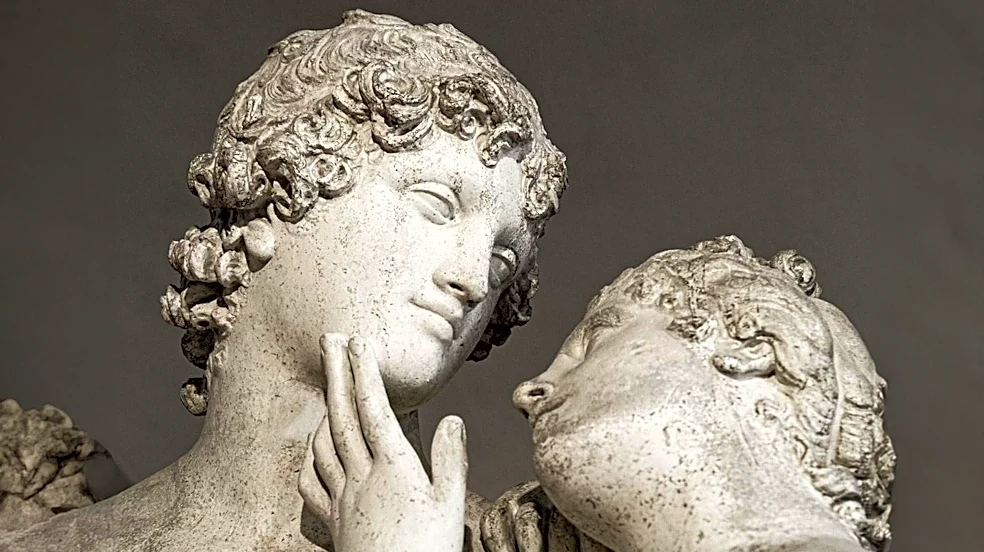
The Roman poet Ovid, in his work 'Metamorphoses,' recounts the tragic love story of Pyramus and Thisbe, two young lovers from Babylon. Pyramus, described as the most handsome of men, and Thisbe, the most beautiful of girls, lived in adjoining houses.
Their parents forbade their union, forcing them to communicate through a crack in a shared wall. They eventually planned to meet secretly outside the city at the tomb of Ninus, under a mulberry tree with white fruit. Thisbe arrived first but fled upon seeing a lioness, dropping her veil. The lioness, with a bloody mouth from a recent kill, tore the veil. Pyramus later found the bloodstained veil and tracks, mistakenly believing Thisbe had been killed by the beast. Overcome with grief, he fell on his sword. His blood stained the mulberry fruit dark. Thisbe returned, discovered Pyramus dying, and, realizing what had transpired, took her own life with his sword. Their parents honored their dying wish for a shared tomb, and the mulberry fruit remains dark as a symbol of their tragic love.
Why It's Important?
The story of Pyramus and Thisbe is a foundational narrative in Western literature, influencing countless works across various art forms. Its themes of forbidden love, misunderstanding, and tragic fate resonate deeply, providing a timeless exploration of human emotion and consequence. For U.S. society, this myth contributes to the rich tapestry of classical education and cultural literacy, often studied in literature and humanities courses. It serves as an archetype for later romantic tragedies, most notably Shakespeare's 'Romeo and Juliet,' demonstrating the enduring power of classical storytelling. The myth also highlights the destructive nature of miscommunication and hasty judgment, offering a cautionary tale that remains relevant in contemporary interpersonal dynamics. Its presence in educational curricula helps foster critical thinking and an appreciation for the origins of literary motifs.
What's Next?
The story of Pyramus and Thisbe will continue to be a subject of academic study, literary analysis, and artistic interpretation. Educators will likely continue to include it in curricula to teach classical mythology, literary themes, and the evolution of storytelling. Artists, writers, and filmmakers may draw inspiration from its core elements to create new works that explore similar themes in modern contexts. Discussions around the myth may also extend to its psychological and sociological implications, examining how societal pressures and individual choices contribute to tragic outcomes. The enduring nature of such classical narratives ensures their continued relevance in shaping cultural understanding and artistic expression for future generations.
Beyond the Headlines
Beyond its literary significance, the myth of Pyramus and Thisbe delves into profound philosophical and ethical questions. It explores the tension between individual desire and societal constraints, the role of fate versus free will, and the consequences of impulsive actions driven by intense emotion. The 'envious wall' separating the lovers can be seen as a metaphor for various barriers—social, cultural, or psychological—that impede human connection. The story also subtly touches upon the power of nature, as the lioness and the mulberry tree play pivotal roles in the unfolding tragedy. Ethically, it prompts reflection on the responsibility of parents in their children's romantic lives and the dangers of unchecked grief. Culturally, it underscores the universal human experience of love and loss, transcending time and geography to speak to fundamental aspects of the human condition. The transformation of the mulberry fruit serves as a powerful, lasting symbol of sacrifice and enduring love.