
What's Happening?
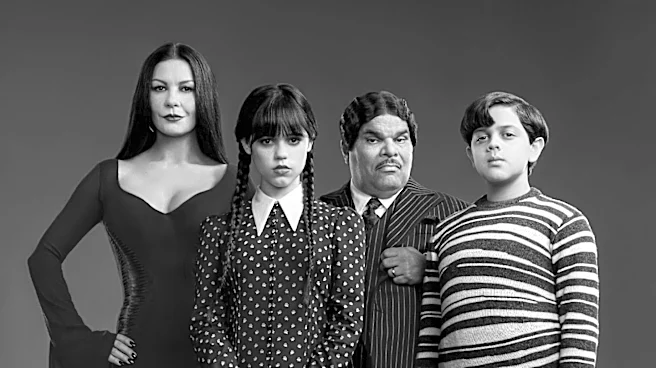
Actress Catherine Zeta-Jones has publicly expressed her strong disapproval of the term 'nepo baby,' calling it 'horrific.' In an interview with 'The Sunday Times,' Zeta-Jones stated that her children,
Dylan and Carys, who are pursuing careers in the entertainment industry, did not ask to be born into the spotlight. She emphasized that both Dylan, an actor, and Carys, who is interested in directing, are working hard to forge their own paths. Zeta-Jones, who achieved her breakthrough role on West End as a teenager in '42nd Street' in 1987 and gained widespread recognition in the UK in 1991 with 'The Darling Buds of May,' highlighted the immense pressure young individuals face in the industry. She noted that if her children were not genuinely talented and passionate, she and her husband, Michael Douglas, would be the first to suggest alternative career paths, such as law.
Why It's Important?
Catherine Zeta-Jones's comments shed light on a contentious issue within the entertainment industry and broader society regarding inherited privilege. The 'nepo baby' label, often used to describe children of famous or influential parents who enter similar fields, has sparked debates about fairness, meritocracy, and the challenges faced by those without such connections. Her perspective is significant because it comes from a prominent figure who has experienced both the struggles of starting a career and the complexities of raising children within a high-profile environment. This discussion impacts public perception of celebrity children, potentially influencing their career trajectories and the types of roles they are offered. It also raises questions about how society values individual effort versus inherited advantage, and whether the term itself is dismissive of genuine talent and hard work.
What's Next?
The ongoing debate surrounding the 'nepo baby' label is likely to continue, with more public figures potentially weighing in on the issue. Zeta-Jones's remarks could encourage other celebrity parents to share their experiences and perspectives on their children's career choices and the societal scrutiny they face. This conversation may lead to a more nuanced understanding of the challenges and opportunities for individuals with famous parents in competitive industries. It could also prompt media outlets and the public to reconsider the implications of using such labels, potentially shifting the focus towards individual achievements and efforts rather than solely on lineage. The discussion might also influence how emerging talent from privileged backgrounds is perceived and evaluated by audiences and industry professionals alike.
Beyond the Headlines
Beyond the immediate discussion of the 'nepo baby' label, Zeta-Jones's comments touch upon deeper societal themes of privilege, opportunity, and the nature of success. The term itself reflects a growing public awareness and critique of systemic advantages, particularly in industries where access and connections play a significant role. This conversation extends beyond entertainment, resonating with broader discussions about economic inequality and inherited wealth. It highlights the tension between the ideal of meritocracy and the reality of inherited social capital. Furthermore, it raises ethical questions about the responsibility of parents to guide their children's careers and the psychological impact of public scrutiny on young individuals trying to establish their own identities and professional lives, irrespective of their family background.