






What's Happening?
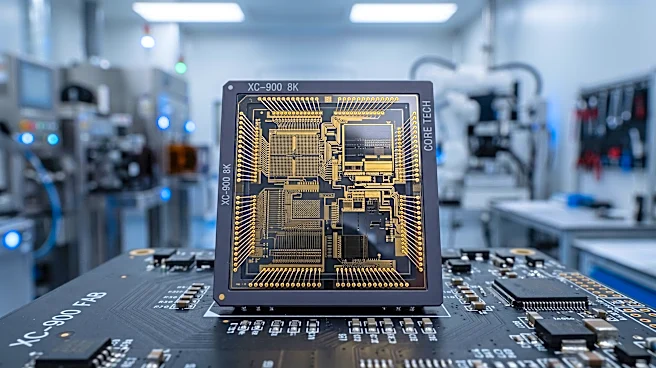
Moonshot AI, a Chinese developer known for its Kimi AI models, has reportedly canceled a $150 million agreement to access advanced Nvidia Blackwell Ultra B300 GPUs. This cancellation stems from new restrictions imposed by the U.S. Bureau of Industry and
Security (BIS). The agreement involved renting computing capacity from a Southeast Asian cloud provider in Indonesia, with access to the GPUs anticipated as early as 2027. The new U.S. regulations specifically target overseas data centers that provide remote access to advanced computing chips for Chinese companies. These rules now require export licenses for certain advanced chip shipments to countries including Indonesia, Malaysia, Singapore, Thailand, and Brazil, and extend regulatory oversight to computing services offered to China-headquartered companies. Moonshot AI had intended for this arrangement to provide access to powerful Nvidia hardware without physically importing the chips into China, but the new U.S. rules have made such cross-border computing arrangements significantly more difficult. The company is reportedly exploring alternative cloud providers in Southeast Asia, though it is uncertain if this will circumvent the regulatory requirements.
Why It's Important?
This development underscores the significant impact of U.S. export controls on the global AI infrastructure market, particularly for Chinese AI developers. Access to advanced GPUs, crucial for training and running large AI models, is no longer solely a financial or technical challenge but has become a major regulatory hurdle. For Chinese AI companies like Moonshot AI, these restrictions could compel them to increasingly rely on domestically produced chips or to find compliant alternatives for their AI development needs. The U.S. Commerce Department's new rule aims to close a loophole that allowed Chinese companies to remotely access AI chips located outside of China, which the U.S. views as undermining its technological advantage. This move is part of a broader U.S. strategy to maintain preeminence in AI, ensuring that U.S.-developed LLMs are chosen over Chinese ones by global consumers and enterprises. The situation highlights a growing tension where U.S. infrastructure, while globally prevalent, has inadvertently facilitated the spread and adoption of Chinese AI models, posing a challenge to U.S. AI dominance.
What's Next?
The immediate consequence for Moonshot AI is the need to re-evaluate its strategy for acquiring the necessary computing power for its AI models. While the company is exploring alternative cloud providers in Southeast Asia, it remains to be seen if these options will fully comply with the new U.S. regulations or if they will face similar restrictions. Data centers currently serving Chinese customers above a certain computing threshold now have a 90-day window to obtain a U.S. license, indicating a period of adjustment and potential disruption for many providers. This regulatory shift is likely to intensify pressure on Chinese AI developers to innovate within their domestic chip ecosystem or to seek out compliant, albeit potentially less powerful, alternatives. The U.S. government's continued focus on controlling access to advanced AI technology suggests that further measures or clarifications regarding export controls could be implemented, continually reshaping the landscape for international AI collaboration and competition.
Beyond the Headlines
The cancellation of Moonshot AI's agreement reveals a deeper geopolitical struggle for technological supremacy, particularly in the field of artificial intelligence. The U.S. strategy, while aiming to secure its AI advantage, faces a paradox: its robust infrastructure and advanced chip technology, widely deployed globally, can inadvertently support the growth of competing AI ecosystems. This situation raises questions about the long-term effectiveness of export controls in an interconnected world, as it could incentivize other nations to accelerate their own domestic chip development and AI capabilities. Furthermore, the emphasis on controlling access to hardware might push Chinese developers towards more efficient software and model architectures, potentially fostering innovation in resource-constrained environments. The ethical and economic implications of such controls are also significant, as they could fragment the global AI research community and create distinct technological blocs, impacting the pace and direction of AI development worldwide.