





What's Happening?
ConocoPhillips (COP) stock has recently closed at US$131.83, drawing attention from investors. Despite a slight dip of 1.0% on the day and 4.0% over the past week, the company maintains strong momentum with a 36.3% year-to-date share price return and a 47.9%
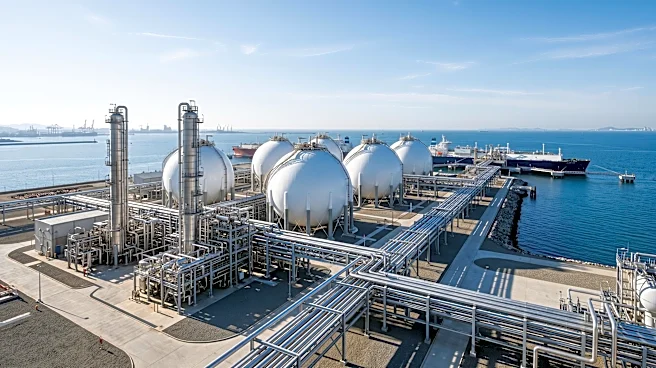
total shareholder return over one year. According to Simply Wall St's analysis, ConocoPhillips appears undervalued, with a fair value estimate of $143.72. This valuation is based on long-term cash flow and project execution, considering the company's expanding Liquefied Natural Gas (LNG) portfolio and progress on large-scale liquefaction projects in Qatar, Port Arthur, and Willow. These projects are anticipated to significantly increase market share due to robust global gas demand, positioning natural gas as a 'transition fuel' and driving substantial free cash flow and revenue growth through 2029.
Why It's Important?
The apparent undervaluation of a major energy producer like ConocoPhillips, despite its strong performance and strategic growth initiatives, presents a complex scenario for investors. On one hand, it suggests a potential buying opportunity if the market is being overly cautious about risks. On the other hand, it could indicate that the market is factoring in potential challenges such as cost overruns in large LNG and oil projects or weaker gas prices impacting cash generation. The company's focus on LNG projects aligns with the global energy transition narrative, where natural gas is seen as a bridge fuel. Success in these projects could solidify ConocoPhillips' position in the evolving energy landscape, benefiting shareholders through increased revenue and free cash flow. Conversely, any setbacks could lead to significant financial implications, affecting investor confidence and the company's market valuation.
What's Next?
Investors will closely monitor the execution and progress of ConocoPhillips' large-scale LNG and oil projects. The company's ability to manage costs and timelines for these projects will be critical in validating its fair value estimate. Future earnings reports and operational updates will provide insights into the financial performance and the impact of these growth initiatives. The broader market sentiment towards natural gas as a transition fuel will also play a role in the stock's trajectory. Analysts will continue to weigh the upside potential against inherent risks, such as commodity price volatility and geopolitical factors. Investors may also look for further insights from financial analysts and research reports to determine if the current market valuation accurately reflects ConocoPhillips' long-term prospects.
Beyond the Headlines
The situation with ConocoPhillips highlights a broader theme in the energy sector: the tension between traditional fossil fuel production and the global push towards cleaner energy. While the company is investing heavily in natural gas, often considered a cleaner alternative to coal, it still operates within a sector facing increasing environmental scrutiny and regulatory pressures. The market's cautious approach, despite strong fundamentals, could reflect these underlying concerns about the long-term viability and social license of fossil fuel companies. This dynamic forces energy companies to balance profitability with sustainability, often leading to strategic shifts and significant investments in new technologies or cleaner energy sources. The perceived undervaluation could also be a symptom of a market that is increasingly prioritizing Environmental, Social, and Governance (ESG) factors, even for companies with strong financial performance.