
What's Happening?
The Asia Pacific Indoor Delivery Robots market is set for substantial expansion, with projections indicating a compound annual growth rate (CAGR) of 23.4% between 2025 and 2033. This growth is driven by
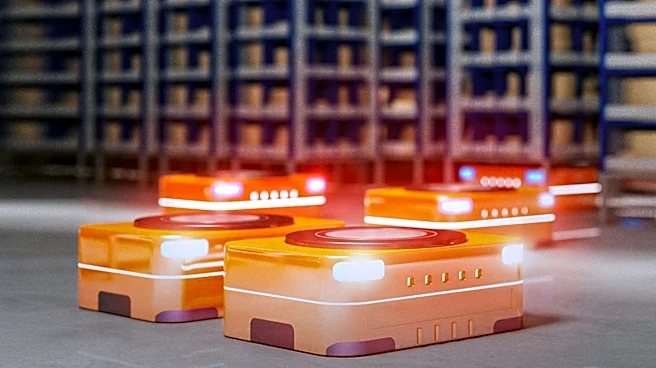
increasing automation across various sectors, including hospitality, healthcare, retail, and commercial facilities. Autonomous service robots are being increasingly adopted in hotels, hospitals, restaurants, shopping malls, and corporate offices for tasks such as room-service delivery, food transportation, medicine distribution, and internal logistics. Key technological advancements, including AI-powered navigation, LiDAR sensors, SLAM technology, and cloud-based fleet management, are enhancing the operational capabilities of these indoor delivery systems. China currently represents the largest market within the Asia Pacific region, while India is emerging as the fastest-growing market due to rising investments in infrastructure and automation. The market encompasses various types of robots, including autonomous mobile robots (AMRs), service delivery robots, and intelligent indoor logistics platforms, all designed to operate within complex indoor environments.
Why It's Important?
The rapid growth of the indoor delivery robots market in Asia Pacific signifies a broader global trend towards automation and efficiency in service industries. For U.S. businesses and technology providers, this presents both opportunities and challenges. U.S. robotics companies may find new markets for their innovations in the Asia Pacific region, particularly in emerging economies like India, which are actively seeking affordable robotic platforms and robotics-as-a-service models. Conversely, the advancements and rapid adoption in Asia Pacific could intensify global competition in the robotics sector, pushing U.S. companies to innovate faster and more efficiently. The increased use of robots for tasks traditionally performed by humans also has implications for labor markets and workforce development, potentially influencing strategies for automation adoption and job retraining in the U.S. Furthermore, the integration of these robots with existing building management systems and enterprise software highlights a growing need for interoperability standards, which could become a focus for international collaboration or competition.
What's Next?
Looking ahead, the Asia Pacific Indoor Delivery Robots market is expected to see continued innovation in robot design, battery performance, and multi-robot coordination. Partnerships between robotics manufacturers, hospitality groups, healthcare networks, and technology providers are anticipated to accelerate commercialization across the region. There will likely be a focus on developing more sophisticated AI-enabled fleet management platforms and multi-floor delivery robots capable of integrating seamlessly with elevators and automatic doors. As the market matures, addressing challenges such as high initial investment costs, integration complexities with existing infrastructure, cybersecurity vulnerabilities, and the need for continuous software updates will be crucial. The demand for affordable robotic platforms and robotics-as-a-service business models is expected to grow, particularly in emerging economies, driving further market expansion and technological refinement. U.S. companies may seek to form strategic alliances or invest in these growing markets to capitalize on the opportunities.
Beyond the Headlines
The proliferation of indoor delivery robots in the Asia Pacific region extends beyond mere operational efficiency; it signals a significant shift in how services are delivered and how human-robot interaction is perceived. Ethically, the increased reliance on robots for tasks like medicine delivery in hospitals raises questions about patient privacy, data security, and the potential impact on the human element of care. Legally, the development of robust regulatory frameworks for robot operation, safety standards, and liability in case of malfunction will become increasingly important. Culturally, the widespread adoption of these robots could alter societal expectations regarding service speed and availability, potentially influencing consumer behavior globally. This trend also highlights a long-term shift towards smart buildings and interconnected infrastructure, where autonomous systems play a central role in daily operations, pushing the boundaries of urban planning and technological integration. The lessons learned and innovations developed in the Asia Pacific market could serve as a blueprint or a cautionary tale for other regions, including the U.S., as they navigate their own paths toward greater automation.