







What's Happening?
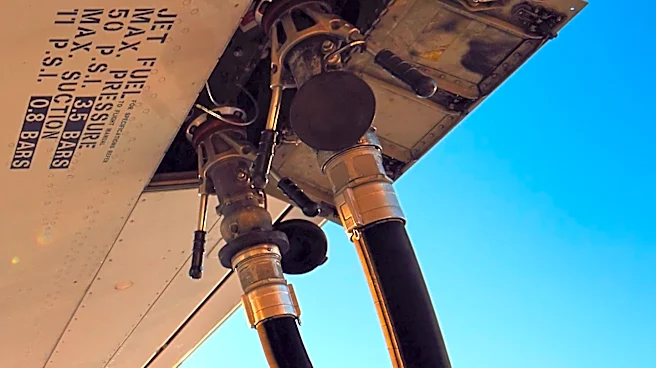
Several major Gulf airports are significantly upgrading their jet fuel infrastructure by adding storage and pipelines, driven by recent security incidents and the need for greater resilience. Dubai is considering fuel storage at its future Al Maktoum
International Airport and a higher-capacity pipeline from Jebel Ali. Abu Dhabi is constructing underground tanks with a capacity for 192 million liters of Jet A-1 near Zayed International Airport, expected to be completed by 2027. QatarEnergy is pursuing a 53 km pipeline from Mesaieed Industrial City to Hamad International Airport, complementing an existing pipeline from Ras Laffan. Jeddah Airports Company is planning a new fuel-farm package for 2Q 2027 as part of an expansion targeting 114 million passengers annually by 2031. These projects aim to improve fuel delivery reliability, increase on-site storage, and enhance physical protection against potential disruptions.
Why It's Important?
These infrastructure enhancements are critical for maintaining operational continuity and ensuring the resilience of major international aviation hubs in the Gulf region. For global airlines and the U.S. aviation industry, disruptions at these key transit points can have cascading effects on flight schedules, cargo operations, and passenger transfers worldwide. Increased fuel storage and redundant supply routes reduce vulnerability to geopolitical instability and localized attacks, which can otherwise lead to significant financial losses and operational chaos. The shift towards underground storage, as seen in Abu Dhabi, also reflects a strategic move to protect critical assets from external threats, setting a precedent for infrastructure development in other sensitive regions. This investment underscores the economic importance of these airports and the imperative to safeguard their functionality.
What's Next?
The ongoing construction and planning phases for these projects indicate a sustained effort to bolster fuel security and operational resilience. The completion of Abu Dhabi's underground tanks by 2027 and Jeddah's new fuel farm by 2Q 2027 will significantly enhance their respective capacities. Dubai's larger fuel line, designed by Germany’s Bilfinger, will increase the annual fuel volume handled, improving supply to Al Maktoum. The effectiveness of these upgrades will be tested by future regional events and the ability of airports to coordinate with military and civilian authorities for threat assessments and rapid service restoration. The long-term impact will be a more robust and secure aviation fuel supply chain in the Gulf, potentially influencing airline route allocations and operational strategies.
Beyond the Headlines
The investment in resilient fuel infrastructure highlights a broader strategic shift in how critical assets are protected in an era of evolving threats. The conflict has demonstrated that relatively inexpensive attacks can disrupt significant economic activity, prompting a re-evaluation of infrastructure design and security protocols. The concept of 'resilience'—the ability to restore operations safely and scale them up quickly—is becoming paramount. This extends beyond physical protection to include redundant systems, diverse fuel sources, and robust coordination mechanisms between military and civilian entities. The economic cost of disruptions, which can unravel airline networks and impact airport revenues, is driving these investments, suggesting that backup infrastructure should be evaluated not just on capacity but on its ability to prevent financial losses and maintain trust with passengers and cargo carriers.