




What's Happening?
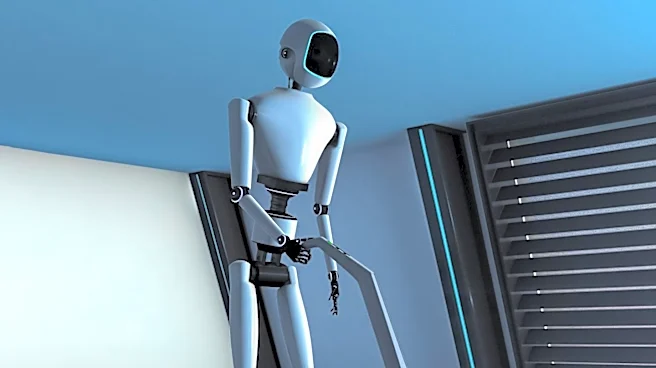
Toyota is developing a new factory robot named ELEY, an acronym for 'Embodied Learning robot for Enhanced Yield,' designed to be soft and human-like in its movements for assembly line tasks. Unlike traditional rigid industrial robots, ELEY incorporates
quasi-direct-drive (QDD) actuators in its joints, allowing its arms to yield to external forces rather than resisting them. This 'softness' is crucial for handling delicate car parts and working safely alongside human employees. ELEY's design mimics human anatomy, including shoulder blades, to facilitate two-handed tasks and improve its range of motion. The robot learns physical tasks by observing and copying human demonstrations, utilizing a method called Diffusion Policy developed by the Toyota Research Institute. This learning approach allows ELEY to handle deformable objects like wire harnesses and rubber seals, which have traditionally required human dexterity. ELEY is wheeled rather than bipedal, optimizing its movement for flat factory floors.
Why It's Important?
The development of ELEY signifies a significant shift in factory automation, particularly within the U.S. automotive manufacturing sector. By creating robots that can work safely and flexibly alongside humans, Toyota aims to enhance productivity and consistency in assembly lines. This 'human-friendly' robotics approach could lead to more collaborative work environments, potentially reducing the need for extensive safety caging and allowing for greater integration of automation into complex tasks. The ability of ELEY to learn from human demonstrations and handle deformable materials addresses a long-standing challenge in robotics, making it possible to automate parts of the final assembly process that previously relied solely on human hands. This could lead to improved quality control, as skills learned once can be replicated consistently across different plants and shifts, ultimately impacting the reliability and finish of vehicles produced in the U.S. and globally.
What's Next?
Toyota plans to run ELEY under conditions close to real production to gather data on its successes and failures, which will be used to further refine its learning capabilities. While a specific deployment schedule for ELEY in U.S. factories has not been announced, the long-term goal is to integrate such robots into final assembly processes. The success of ELEY could influence other automakers to adopt similar 'soft' robotics and human-imitation learning methods, potentially transforming the landscape of manufacturing jobs and factory layouts. The focus will be on improving the robot's reliability during long hours of operation and its repeatability in precise tasks. If successful, ELEY-like robots could move beyond material handling to more intricate assembly work, impacting the efficiency and quality standards of the U.S. automotive industry. The broader implications include a potential increase in automation in sectors requiring delicate handling and human-robot collaboration.
Beyond the Headlines
The introduction of 'soft' robots like ELEY reflects a deeper philosophical alignment with Toyota's production system, particularly the concept of 'jidoka' or 'automation with a human touch.' This approach emphasizes machines stopping when abnormalities occur, allowing human intervention and problem-solving. ELEY embodies this by yielding to unexpected forces, promoting a symbiotic relationship between human workers and machines rather than full replacement. This could lead to a redefinition of manufacturing roles, where human workers focus on oversight, problem-solving, and training, while robots handle repetitive or physically demanding tasks. Ethically, this development raises questions about the future of labor, the balance between automation and human employment, and the psychological impact of working alongside increasingly human-like machines. The emphasis on safety and collaboration could set new standards for industrial robotics, fostering a more integrated and less confrontational view of automation in the workplace.