



What's Happening?
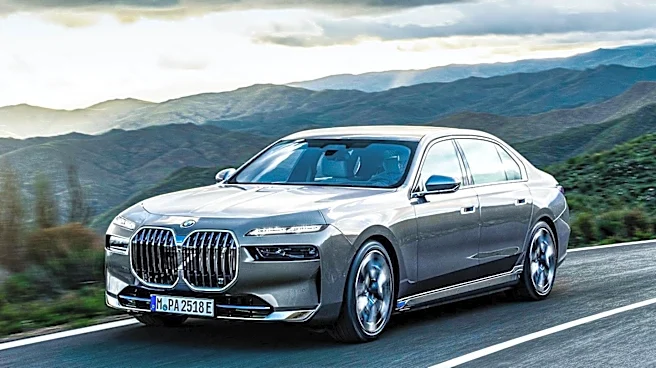
BMW is set to release Software Update 11/2026.3 in December 2026, which will introduce five new functions and enhance 19 others across various vehicle systems. A significant update for U.S. drivers is the expansion of the Highway & Commuting Assistant
to include city stop-and-go capabilities. This new feature will allow vehicles to automatically brake to a standstill when detecting a red traffic light and either automatically resume driving or prompt the driver to proceed when the light turns green. This functionality marks a notable shift, as the assistant was previously designed primarily for highway and commuting use. The update will be available for vehicles equipped with BMW Operating System X, and BMW states that 16 million of its vehicles across 88 countries are capable of receiving over-the-air updates.
Why It's Important?
This update signifies a major advancement in autonomous driving technology for the U.S. market, extending driver assistance systems from controlled highway environments into more complex urban settings. The introduction of city stop-and-go functionality could enhance convenience for drivers, potentially reducing fatigue in stop-and-go traffic conditions. However, it also introduces new safety considerations, as urban environments present a higher density of variables such as pedestrians, cross-traffic, and varied signal interpretations. The successful implementation and reliability of this feature will be crucial for public acceptance and the future development of more comprehensive autonomous driving systems. The move also highlights BMW's strategy of treating automation as a software-extendable capability rather than a fixed feature at the point of sale, potentially influencing how other automakers approach software updates and feature deployment.
What's Next?
The rollout of BMW Software Update 11/2026.3 is scheduled to begin in December 2026. Following the deployment, the key will be to observe how effectively the city stop-and-go feature performs in real-world urban conditions in the U.S. BMW will need to address potential challenges related to signal detection accuracy, false braking incidents, and safe interaction with other road users. The company's approach to driver prompts versus full automation at green lights will also be under scrutiny, as it reflects a balance between advanced assistance and driver responsibility. Future developments will likely involve further refinements to the system based on user feedback and performance data, as well as potential expansion to more vehicle models and operating systems.
Beyond the Headlines
The expansion of driver assistance systems into urban environments raises complex ethical and legal questions, particularly concerning liability in the event of accidents. As vehicles take on more decision-making responsibilities, the line between driver and system accountability becomes increasingly blurred. The safety analysis frameworks, such as ISO 26262 and ISO 21448 (SOTIF), will be critical in evaluating the performance and safety of these advanced features. Furthermore, the ability to deliver significant functional changes over-the-air transforms release engineering into a safety-critical activity, requiring robust processes for change impact analysis, regression verification, and cybersecurity. This trend could accelerate the shift towards software-defined vehicles, where functionalities are continuously updated and improved post-purchase, fundamentally altering the automotive ownership experience.