





What's Happening?
NVIDIA Corporation (NASDAQ:NVDA) is reportedly considering shipping its next-generation Rubin Ultra GPU with less high-bandwidth memory (HBM) than initially announced. According to The Information, the company has been testing at least three versions
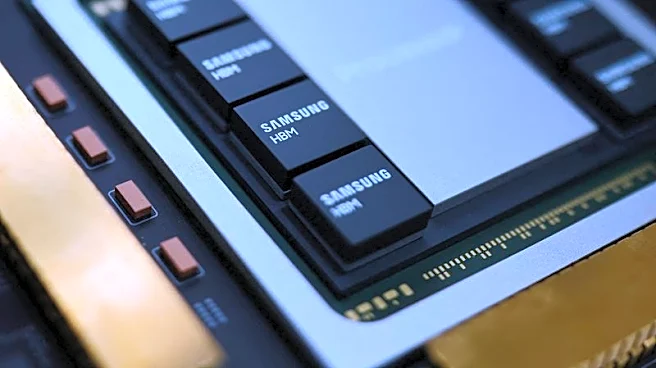
with reduced HBM, some as low as 192GB to 256GB, significantly below the 1 terabyte previously stated by Jensen Huang. This potential move comes as the entire industry faces a severe memory shortage, impacting both NVIDIA and its competitors. Meanwhile, rival Advanced Micro Devices, Inc. (NASDAQ:AMD) is proceeding with its Helios AI system, which is slated for customer shipments later this year and claims to have secured the necessary memory. NVIDIA's decision could be a strategy to maintain production volume and potentially offer a cheaper option, despite the fact that HBM can constitute over half the cost of an advanced AI chip.
Why It's Important?
NVIDIA's potential decision to reduce memory in its next-generation AI chips has significant implications for the U.S. AI and semiconductor industries. A memory downgrade could force AI companies to purchase more chips to run the same large models, potentially increasing overall costs for customers even if the per-chip price decreases. This highlights the critical impact of supply chain constraints, particularly the severe memory shortage, on the development and deployment of advanced AI systems. For NVIDIA, it represents a balancing act between maintaining market dominance and navigating supply challenges. For AMD, it presents an opportunity to gain market share, especially if its claims of secured HBM supply hold true. The situation underscores the intense competition and strategic maneuvering within the AI chip market, where access to critical components can dictate market leadership and technological advancement.
What's Next?
NVIDIA's Rubin Ultra GPU is not expected to ship until late 2027, providing the company with time to finalize its memory configurations. NVIDIA has also taken steps to secure future memory supply through a $500 billion partnership with SK Hynix's parent company for co-development of memory technology. The market will closely watch whether NVIDIA ultimately proceeds with reduced memory versions and how this impacts customer adoption and competitive dynamics. AMD's Helios system, with its secured HBM supply and commitments from major customers like Microsoft, Meta, OpenAI, and Oracle, will serve as a key benchmark. The ongoing memory shortage will likely continue to influence strategic decisions and partnerships across the AI chip ecosystem, with companies prioritizing supply chain resilience and component access.
Beyond the Headlines
The memory shortage and NVIDIA's response reveal a deeper vulnerability in the global technology supply chain, particularly for high-demand components essential for cutting-edge AI. This situation could accelerate efforts by major tech companies to diversify their supply chains or even invest in memory manufacturing capabilities. Ethically, the potential for AI companies to be forced into buying more chips due to memory constraints raises questions about cost efficiency and resource allocation in an industry already grappling with high energy consumption. Furthermore, the competition between NVIDIA and AMD over memory supply could drive innovation in memory technology itself, leading to more efficient and higher-capacity solutions in the long term. This scenario also highlights the strategic importance of vertical integration and control over critical components in maintaining technological leadership.