







What's Happening?
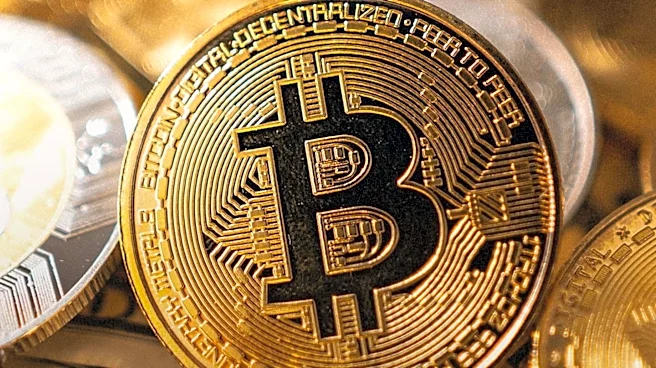
Gold and Bitcoin, which were among the worst-performing major assets for most of 2026, experienced a rally the morning after the midterm elections. Gold futures (GC=F) jumped over 3%, surpassing $4,000 an ounce, while Bitcoin (BTC-USD) rose nearly 4%,
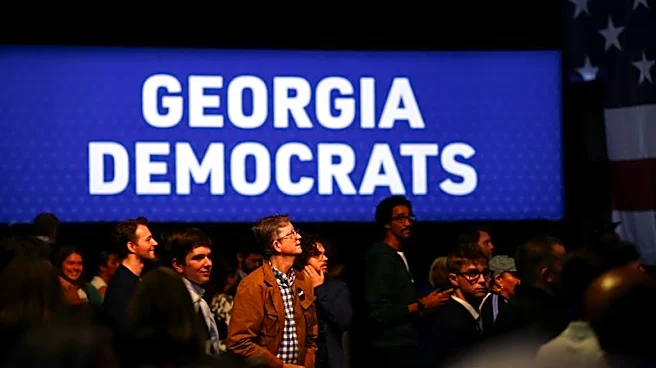
moving above $80,000. Silver (SI=F) also saw significant gains, increasing by about 5%. This rally occurred as the dollar index (DX-Y.NYB) slipped, particularly following a Democratic sweep of Congress. This market reaction is interpreted as a 'debasement trade,' where investors move into assets not subject to government printing in anticipation of potential dollar devaluation due to large deficits and easy money policies. Despite this post-election bounce, both gold and Bitcoin remain significantly below their previous peaks, with gold futures down about 26% from its January 29 record and Bitcoin down 38% from its October 2025 peak.
Why It's Important?
The post-midterm rally in gold and Bitcoin signals investor sentiment regarding future economic and political stability. The immediate reaction suggests that market participants are anticipating potential shifts in fiscal policy or increased government spending under a new congressional landscape, which could lead to inflationary pressures or a weakening dollar. This 'debasement trade' highlights the role of these assets as hedges against economic uncertainty and currency devaluation. The performance of gold and Bitcoin after the elections provides insight into how investors perceive the impact of political outcomes on traditional and digital financial markets. While the rally offers a temporary reprieve for these assets, their overall performance in 2026 indicates a challenging year, suggesting that broader economic factors and monetary policies continue to exert significant influence. The Treasury's recent adjustment to its borrowing guidance, opening the door for changes in debt sales, further adds to market speculation regarding future economic conditions.
What's Next?
The immediate aftermath of the midterm elections has provided a short-term boost for gold and Bitcoin, but the sustainability of this rally remains to be seen. The market will be closely watching upcoming economic indicators and any policy signals from the newly configured Congress. A key event on the horizon is December's budget fight in Washington, which could further influence investor sentiment regarding fiscal policy and the dollar's strength. Wells Fargo Investment Institute suggests that gold's jump may reflect 'less political certainty in the U.S. going forward, as well as lower inflation-adjusted interest rates.' However, they also predict that the dollar may win the longer game, supported by a comparatively hawkish Federal Reserve, elevated Treasury yields, and favorable U.S. growth through 2027. The Treasury's revised borrowing guidance will also be a factor, as any changes in debt issuance could impact bond markets and broader economic liquidity.
Beyond the Headlines
The post-election rally in gold and Bitcoin, despite their poor year-to-date performance, underscores the persistent narrative of these assets as safe havens or inflation hedges, particularly in times of political transition or economic uncertainty. This event highlights the complex interplay between political outcomes, monetary policy expectations, and asset valuations. The 'debasement trade' theory, while not always consistently playing out, resurfaces during periods where investors perceive a risk of currency debasement. The fact that both traditional (gold) and modern digital (Bitcoin) 'anti-fiat' assets reacted similarly suggests a common underlying concern among a segment of investors. This could also reflect a growing sophistication in how market participants view and utilize digital assets alongside traditional ones in their hedging strategies, further blurring the lines between conventional and crypto finance in response to macroeconomic and political shifts.