


What's Happening?
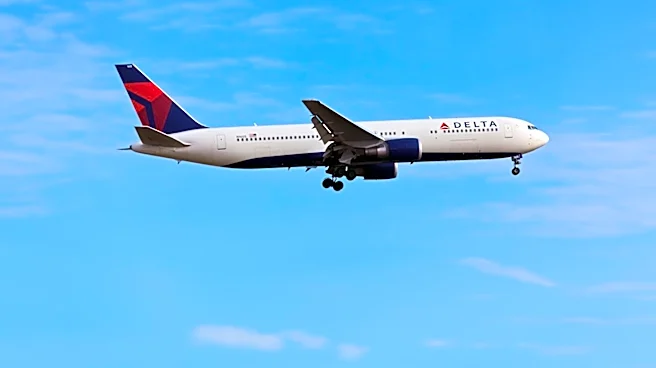
Berkshire Hathaway CEO Greg Abel has consistently increased the company's stake in Delta Air Lines (DAL) for three consecutive quarters. In the first quarter of 2026, Berkshire acquired Delta shares valued at $2.65 billion. The second quarter saw a 44%
increase in its Delta holdings, followed by another 12% increase in the third quarter, bringing the total to 64,450,000 shares, as reported in its latest 13F filing on November 16. This makes Berkshire Hathaway one of Delta's largest shareholders. This investment strategy marks a significant departure from the approach of the previous CEO, Warren Buffett, who divested from all major U.S. airline stocks in May 2020, citing concerns about the industry's debt and vulnerability to external shocks like the COVID-19 pandemic. Abel's continued investment suggests a different outlook on Delta's financial health and future prospects.
Why It's Important?
Greg Abel's sustained investment in Delta Air Lines signals a potential shift in Berkshire Hathaway's investment philosophy under new leadership, particularly concerning industries previously deemed problematic by Warren Buffett. This move is significant because it indicates confidence in Delta's ability to mitigate the risks that concerned Buffett. Delta's strategic initiatives, such as its American Express deal projected to exceed $9 billion for the full year, and its focus on premium travelers, which led to a 17% year-on-year growth in main cabin unit revenue, are likely factors influencing Abel's decision. Furthermore, Delta's plan to reduce over $2 billion in debt by 2026 addresses one of Buffett's primary concerns about airline stocks. This investment could set a precedent for how Berkshire Hathaway approaches other sectors that might have been overlooked in the past, potentially impacting market perceptions of the airline industry and other 'old economy' sectors.
What's Next?
The continued accumulation of Delta Air Lines stock by Berkshire Hathaway under Greg Abel suggests a long-term commitment to the airline. Future developments will likely include monitoring Delta's financial performance, particularly its debt reduction efforts and the success of its premium travel strategy. The market will also be watching for further investment decisions by Abel that diverge from Buffett's historical preferences, such as the recent investment in the tech company Bending Spoons. These actions could indicate a broader strategic re-evaluation within Berkshire Hathaway, potentially leading to investments in other growth-oriented or technology-driven sectors. The success or failure of these new investment directions could influence future market trends and investor confidence in both Berkshire Hathaway and the companies it chooses to back.
Beyond the Headlines
Greg Abel's investment in Delta Air Lines, contrasting with Warren Buffett's previous stance, highlights a generational and strategic evolution within Berkshire Hathaway. This isn't merely an investment decision; it reflects a changing perspective on market dynamics and risk assessment. Buffett's concerns about airlines were rooted in their capital-intensive nature and susceptibility to external shocks. Abel's approach suggests a belief that specific companies, like Delta, have adapted their business models sufficiently to overcome these inherent challenges. This divergence also underscores the ongoing debate about the relevance of 'value investing' in a rapidly changing global economy, where technological innovation and new business models are constantly emerging. The move could inspire other large investment firms to re-evaluate their traditional sector biases and consider opportunities in industries that have undergone significant transformation.