




What's Happening?
TAP Air Portugal has launched 'economy prime,' a new cabin product designed to bridge the gap between economy and business class on its long-haul flights. Unlike traditional premium economy, which typically offers recliner seats and extra legroom, economy prime provides
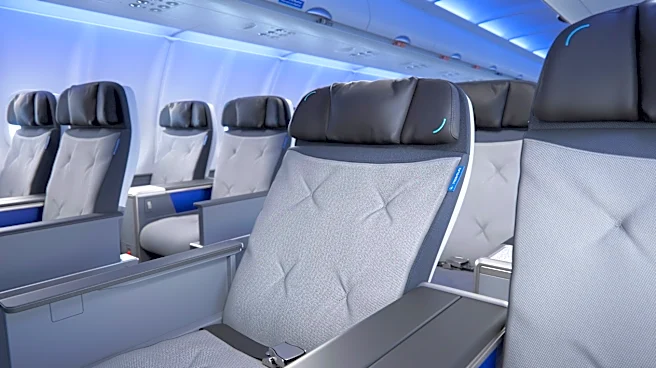
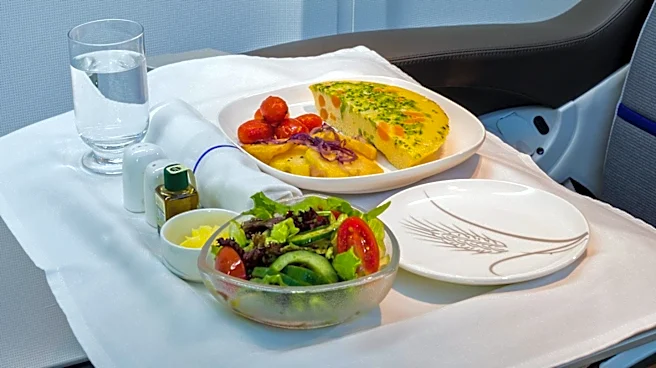
a standard economy layout but guarantees a 'neighbor-free' seat. This means each of the 12 seats in the first three rows of the economy cabin has an empty seat beside it, offering more space and privacy. The product is available on TAP's Airbus A330 and A321LR aircraft. While it includes perks like premium check-in, premium boarding, and fast-track security (though some airport benefits were inconsistent in practice), it does not provide lounge access. Economy prime passengers also receive an amenity kit, a premium pillow, enhanced headphones, and upgraded meal service with ceramic dishes and metal cutlery. The cost varies significantly, sometimes being only slightly more than a standard economy ticket.
Why It's Important?
TAP Air Portugal's 'economy prime' represents an innovative approach to premium economy, focusing on personal space and comfort rather than just seat design. This model could appeal to budget-conscious travelers seeking more comfort without the significant price jump to business class. The 'neighbor-free' concept addresses a common complaint in economy travel—lack of personal space—and could influence other airlines to explore similar offerings. The varying price points make it an accessible upgrade for some, potentially democratizing a more comfortable flying experience. For the airline, it allows for revenue optimization by offering a differentiated product within the economy cabin. The inconsistency in advertised airport perks highlights a challenge in rolling out new services, where operational execution needs to match marketing promises to maintain customer satisfaction and trust.
What's Next?
As TAP Air Portugal continues to roll out and refine its 'economy prime' product, it will likely gather feedback from passengers to address inconsistencies in airport benefits and potentially enhance other aspects of the service, such as in-flight technology and meal variety. The success of this 'neighbor-free' concept could prompt other airlines, particularly those in competitive long-haul markets, to introduce similar offerings or adapt their premium economy strategies. Travelers considering TAP will need to weigh the value of the extra space against the cost and the potential for inconsistent airport perks. Future developments might include making economy prime bookable with miles, which is not currently an option, further increasing its appeal to frequent flyers.
Beyond the Headlines
The introduction of 'economy prime' reflects a broader industry trend of airlines segmenting their cabins to cater to a wider range of passenger preferences and budgets. By offering a 'neighbor-free' seat, TAP is tapping into the psychological value of personal space, which for many travelers is as important as, if not more than, extra legroom or a wider seat. This product could also be seen as a response to the increasing demand for more comfortable travel experiences in a post-pandemic world, where personal space and hygiene have gained heightened importance. The challenge for TAP and other airlines adopting similar models will be to effectively communicate the value proposition and ensure consistent delivery of all advertised benefits to manage customer expectations and build loyalty in a highly competitive market.