


What's Happening?
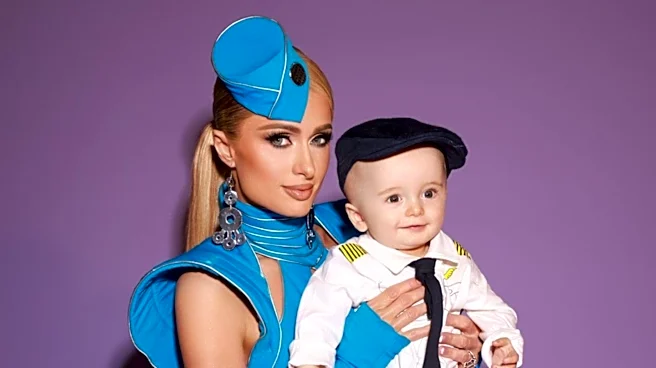
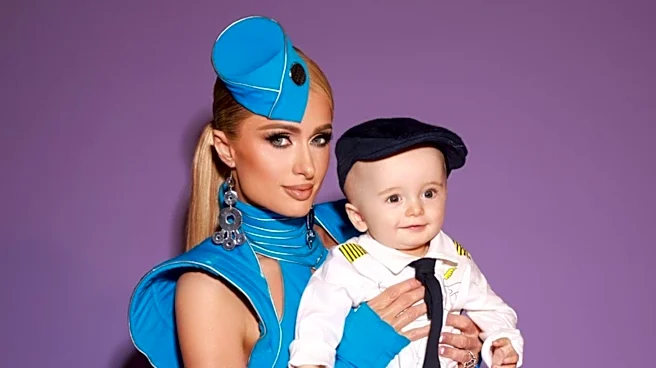
Paris Hilton is facing online criticism for her family's 'Beauty and the Beast' themed Halloween costumes. Hilton dressed as Belle, her husband Carter Reum as the Beast, their son Phoenix as Lumière, and their two-year-old daughter London as Chip, the enchanted
teacup. The backlash stems from social media users questioning why Hilton chose to portray the central princess while her young daughter was assigned a household object character, rather than another prominent female character from the film. Hilton shared photographs and behind-the-scenes footage of the family photoshoot on Instagram, captioning the post, 'My life is a fairytale, and the magic never ends.' Despite the coordinated and elaborate nature of the costumes, the distribution of roles has ignited debate among her followers, with some calling the choice 'narcissistic' and suggesting the children should have been the main characters.
Why It's Important?
This incident highlights the broader scrutiny public figures, particularly celebrities, face regarding their parenting choices and public image. The online debate reflects evolving societal expectations around gender roles and representation, even in seemingly innocuous contexts like Halloween costumes. While some view it as a harmless family activity, others interpret the costume assignments as reinforcing traditional or even self-centered narratives, where the adult takes the most prominent role at the expense of a child's potential for a more central character. The swift and vocal online reaction underscores the power of social media in shaping public perception and generating discussions on celebrity behavior, demonstrating how even personal family moments can become subjects of widespread public commentary and criticism.
What's Next?
It is likely that Paris Hilton will continue to navigate public opinion regarding her family's choices, as celebrity actions often remain subjects of ongoing discussion on social media platforms. While she has not directly addressed the specific criticisms regarding London's costume in the provided information, her past behavior suggests she may continue to share aspects of her family life, potentially leading to further commentary. The incident may also prompt other public figures to consider the potential implications of their costume choices for their children, especially in an era where online communities are quick to analyze and critique such decisions. The broader conversation about representation in children's media and character roles could also see continued engagement.
Beyond the Headlines
Beyond the immediate controversy, this event touches upon deeper cultural discussions about childhood, celebrity, and the performance of family life in the digital age. The expectation for children to be central figures in their own narratives, even in playful contexts, reflects a shift in parenting philosophies and public discourse. The criticism directed at Hilton, despite the apparent joy of her children in the photos, suggests a societal desire for authenticity and equitable representation, even within a family unit. It also underscores the double-edged sword of social media for celebrities: a platform for sharing personal moments that simultaneously opens them up to intense public judgment and interpretation, often detached from the original intent or context.