






What's Happening?
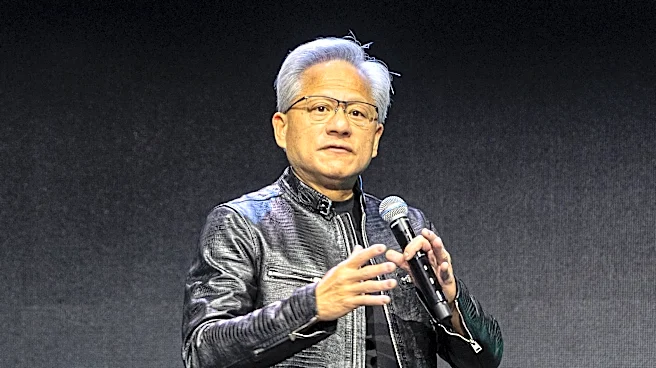
Nvidia's board of directors is under increasing pressure to establish a formal written succession plan for its CEO, Jensen Huang. This call for greater governance transparency comes after recent market turmoil, where a selloff linked to changes involving
Huang pushed two major indices into correction territory. Erik Gordon, a business professor at the University of Michigan's Ross School of Business, highlighted the fragility of a $4 trillion company's reliance on a single executive without a clear succession strategy. Gordon argues that the absence of such a plan constitutes 'almost per se wrongdoing by the board.' Although markets rebounded following Huang's reinstatement, the underlying vulnerability regarding leadership succession remains unaddressed, prompting calls for the board to issue a statement on its succession planning.
Why It's Important?
The situation at Nvidia underscores a significant governance concern for large corporations, particularly those with substantial market capitalization and influence on broader economic indices. The fact that a single executive's status could trigger a market correction demonstrates the systemic risk associated with inadequate succession planning in key leadership roles. For investors, this highlights the potential for unexpected volatility and financial losses, even in seemingly stable and high-performing companies. The debate also brings into focus the responsibilities of corporate boards to ensure long-term stability and protect shareholder interests by mitigating 'key person risk.' A lack of transparency in succession planning can erode investor confidence and lead to increased scrutiny from financial analysts and regulatory bodies.
What's Next?
The immediate focus will be on any response from Nvidia's board regarding a formal succession plan. A public statement or the implementation of a written strategy would be a crucial signal to investors and the market, potentially alleviating concerns about future leadership transitions. Failure to address this governance issue could lead to continued investor unease and potentially impact the company's stock performance and valuation. Additionally, this incident may prompt broader discussions within the corporate governance community about the necessity of robust succession planning, especially for companies whose market influence is significant enough to affect major economic indices. Other companies with highly influential CEOs might also face increased pressure to disclose their succession strategies.
Beyond the Headlines
This event transcends Nvidia, raising fundamental questions about corporate governance in the era of highly influential tech leaders. The 'key person risk' highlighted by Professor Gordon points to a broader issue where the perceived indispensability of a single individual can create systemic vulnerabilities, not just for the company but for the entire market. It challenges the notion that a company's success is solely tied to one visionary leader, emphasizing the importance of institutional resilience and distributed leadership. Ethically, it raises questions about the board's fiduciary duty to shareholders when such a critical aspect of long-term stability is not formally addressed. Culturally, it reflects a potential over-reliance on charismatic founders in the tech industry, which may need to evolve towards more structured and sustainable leadership models.