

What's Happening?
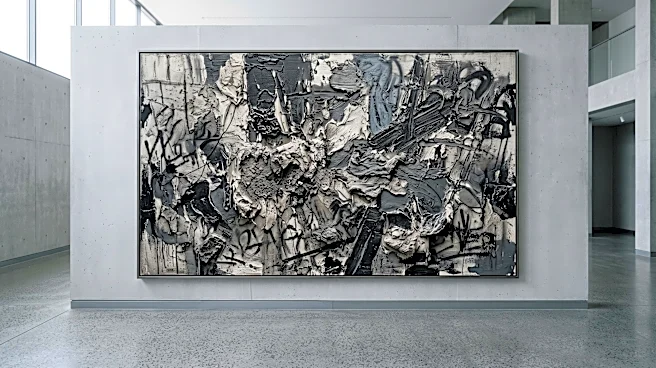
Filmmaker Josh Safdie, known for 'Uncut Gems' and 'Good Time,' has ventured into contemporary printmaking with his new work, 'Top 10 NYC Films.' What began as an intention to list ten landmark films about New York City evolved into a dense, layered artistic
object featuring 115 titles. The print, published in 2026 by Two Palms studio, utilizes a sophisticated 20-color screen-printing process to recreate the raw, handwritten appearance of Safdie's original notes, complete with multiple layers of corrections and revisions. The large-format piece (approximately 99.1 × 112.4 cm) incorporates various masking techniques, such as hand-applied paint, glued paper, and crackle paint, to create a visual hierarchy among the film titles. The work prioritizes films that capture the 'essence of New York' through sensory details rather than traditional cinematic canon. The Whitney Museum of American Art has already added this print to its permanent collection, recognizing its documentary and artistic value. The official launch occurred at a charity event at Christie's New York, with all proceeds from the limited edition of 50 signed copies benefiting the IFPDA Foundation to support the printmaking community.
Why It's Important?
This development signifies a notable expansion of Josh Safdie's artistic practice beyond filmmaking into the realm of fine art printmaking. His entry into this medium, with a piece immediately recognized and acquired by a prestigious institution like the Whitney Museum, underscores the growing cross-pollination between different artistic disciplines and the art market's interest in established creators from other fields. The work itself, by transforming a simple list into a complex visual narrative, challenges conventional notions of artistic expression and curation. It highlights how personal obsessions and creative processes can become art objects, offering a unique insight into a filmmaker's influences and perceptions of a city. The philanthropic aspect, with all proceeds supporting the printmaking community, also emphasizes a commitment to artistic infrastructure and the broader cultural ecosystem, potentially inspiring other artists to engage in similar initiatives. This project could also influence how film history and urban narratives are visually documented and interpreted within contemporary art.
What's Next?
The limited edition print, priced at $6,500 USD, is currently subject to a waiting list managed by Two Palms and the IFPDA, indicating strong market demand. The acquisition by the Whitney Museum suggests that 'Top 10 NYC Films' will be preserved and potentially exhibited, offering broader public access to Safdie's printmaking debut. This successful foray into printmaking may encourage Safdie to explore more visual art projects, potentially leading to future exhibitions or collaborations in the fine art world. The charitable model of the print's sale could also serve as a precedent for other artists looking to combine commercial success with philanthropic goals within the art community. Furthermore, the work's unique approach to cataloging cinematic influences might inspire new forms of artistic and academic discourse around film history and urban studies.
Beyond the Headlines
Beyond its immediate artistic and commercial success, Safdie's 'Top 10 NYC Films' print delves into deeper implications regarding the nature of artistic creation and the representation of urban identity. The work's chaotic, layered aesthetic, mirroring the 'tight editing' of his films, suggests a commentary on the overwhelming and subjective experience of engaging with a city like New York. It blurs the lines between personal archive, critical commentary, and artistic expression, inviting viewers to consider the subjective filters through which cultural narratives are constructed. Ethically, the project raises questions about the commodification of personal taste and the transformation of intellectual property (film titles) into fine art. Culturally, it reinforces New York City's enduring status as a muse for artists across various mediums, while also offering a unique, non-traditional 'map' of its cinematic soul. This piece could be seen as a significant contribution to the ongoing dialogue about how artists interpret and re-present their influences and environments.