



What's Happening?
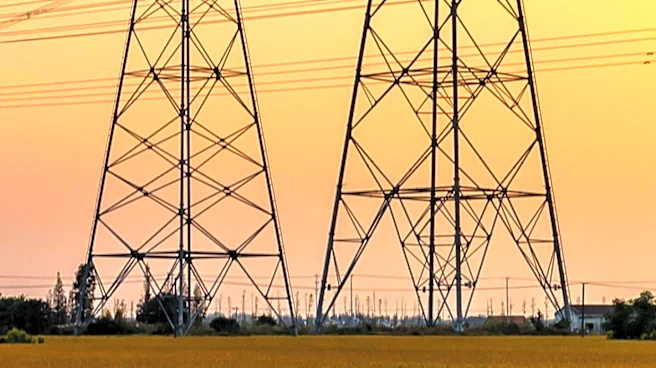
The European Union-ASEAN Business Council (EU-ABC) is advocating for a flagship partnership between the EU and ASEAN to develop the ASEAN Power Grid (APG). This initiative aims to foster regional economic integration in Southeast Asia through technical
and financial support from the EU, leveraging its experience in interconnected electricity systems. The EU has already allocated 105 million euros (US$117 million) in grant funding for sustainable connectivity and green transition initiatives under 'Team Europe.' The EU-ABC also calls for increased high-level political engagement between the two blocs across various sectors, including digital, finance, energy, and health. Furthermore, the council is pushing for the establishment of a region-to-region free trade agreement (FTA) to enhance trade and investment, with nearly three-quarters of European business respondents in a recent survey believing an ASEAN-wide FTA would be more beneficial than individual bilateral agreements.
Why It's Important?
This push for a comprehensive EU-ASEAN partnership, particularly on the ASEAN Power Grid and a regional FTA, holds significant implications for global trade and energy security. For the EU, it represents an opportunity to strengthen its economic and political influence in a rapidly growing region, diversifying its supply chains and market access. For ASEAN, the partnership could accelerate its energy transition and economic integration, attracting substantial European investment and expertise. A regional FTA would streamline trade, reduce barriers, and potentially create a more resilient economic architecture, benefiting businesses and consumers in both regions. The emphasis on sustainable connectivity and green transition aligns with global efforts to combat climate change, positioning both blocs as leaders in green initiatives. This collaboration could also serve as a counterweight to other major economic powers, fostering a more balanced global economic landscape.
What's Next?
The EU-ABC envisions the power grid partnership and a region-to-region economic architecture as key outcomes to mark the 50th anniversary of ASEAN-EU relations in 2027. The council hopes that negotiations for a regional FTA will be launched next year, coinciding with this milestone. Increased high-level political engagement from the EU at ASEAN forums is expected to facilitate these discussions and broaden cooperation across various sectors. While the EU currently has FTAs with Singapore and Vietnam, and agreements with Indonesia and the Philippines are pending ratification, the focus will shift towards a comprehensive regional deal. The success of these initiatives will depend on sustained political will and practical cooperation from both sides, aiming for tangible outcomes that deliver commercial rewards and broad economic benefits across Southeast Asia.
Beyond the Headlines
The proposed EU-ASEAN partnership extends beyond immediate economic gains, touching upon deeper geopolitical and strategic considerations. By fostering stronger ties with ASEAN, the EU is implicitly strengthening its position in the Indo-Pacific region, a critical area for global trade and security. The emphasis on the ASEAN Power Grid highlights a growing recognition of the interconnectedness of energy infrastructure and its role in regional stability and development. A successful regional FTA could set a precedent for other inter-regional trade agreements, promoting a more integrated and rules-based global trading system. This initiative also underscores the evolving nature of international relations, where economic partnerships are increasingly intertwined with strategic alliances and shared values, such as sustainability and regional integration. The long-term impact could reshape global trade routes and energy landscapes, fostering greater resilience and cooperation.