










What's Happening?
Helisul Group, a pioneer in Latin American helicopter operations since 1972, is significantly expanding its services, particularly in human external cargo (HEC-B) longline missions. Headquartered in Brazil with operations in Chile and Ecuador, Helisul operates
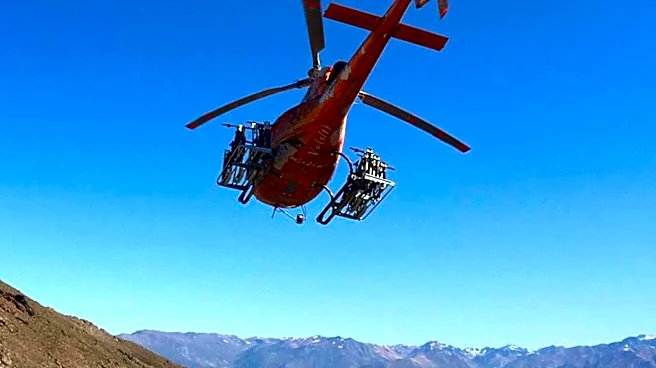
a fleet of 75 helicopters and offers a wide range of services, including aeromedical, disaster response, public safety, mining support, and powerline inspection. The company recently achieved the region's first approval for Class B HEC-B longline missions, a certification secured with the assistance of Canadian company Boost Systems, a provider of certified HEC systems and training. This new capability allows Helisul to offer solutions for maintenance and repairs on transmission lines, reducing the time linemen are exposed to risks during live-line work. Helisul has invested heavily in Boost Systems technology, specialized equipment, and advanced training, emphasizing safety as a strategic pillar.
Why It's Important?
The expansion of Helisul Group's HEC-B operations signifies a major advancement in critical infrastructure maintenance and emergency response capabilities across Latin America. For U.S. companies like Boost Systems, this partnership demonstrates the global demand for specialized aviation technology and training, opening avenues for international market penetration and collaboration. The ability to perform live-line maintenance with helicopters significantly enhances the efficiency and safety of power grid operations, which is vital for economic stability and development in the region. This innovation reduces downtime for electrical utilities and minimizes risks for ground crews, potentially setting new industry standards. The adoption of advanced safety protocols and training, as highlighted by Helisul's commitment, also underscores a growing emphasis on best practices in hazardous aerial operations, which could influence safety standards globally.
What's Next?
Helisul Group plans to further explore other HEC-B applications, including rescue and avalanche control, indicating a broader integration of this advanced capability into various sectors. The company's success in Brazil and Chile is expected to spark a broader shift in South America, with more utilities and operators in countries like Ecuador and Argentina showing interest in adopting HEC-B operations. This anticipated snowball effect could lead to increased demand for specialized helicopters, equipment, and training services from providers like Boost Systems. Helisul will continue to work closely with Boost Systems for recurrent training and operational feedback, ensuring the ongoing safety and efficiency of their HEC-B programs. This continuous improvement model is likely to become a benchmark for other operators entering this specialized field.
Beyond the Headlines
The development of HEC-B operations by Helisul Group, supported by Boost Systems, represents more than just a technological advancement; it reflects a paradigm shift in how high-risk industrial tasks are approached. The emphasis on reducing human exposure to danger through innovative aerial solutions highlights an evolving ethical consideration in industrial safety. This trend could lead to a re-evaluation of traditional methods in other hazardous industries, promoting the adoption of remote or aerial technologies to protect workers. Furthermore, the international collaboration between Helisul and Boost Systems exemplifies how cross-border partnerships can drive innovation and elevate safety standards globally, fostering a more interconnected and resilient infrastructure network. The long-term implications include a potential decrease in industrial accidents and a more efficient, safer approach to maintaining essential services.