






What's Happening?
Duke Energy has launched the PowerPair NC rebates program, an incentive designed to encourage residential customers in North Carolina to install solar panel systems combined with certified battery storage solutions. This program, administered by Duke Energy Carolinas
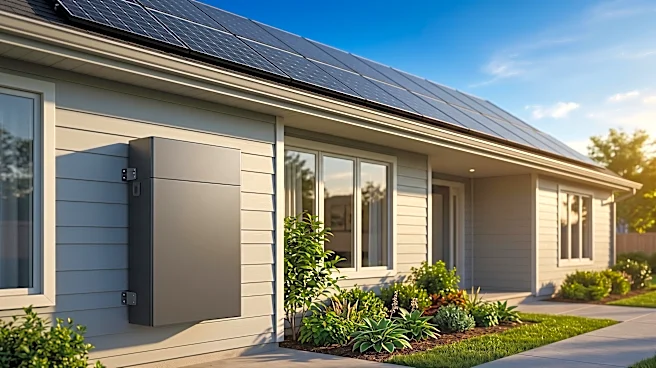
(DEC) and Duke Energy Progress (DEP), aims to alleviate peak load demands on the local electric grid during periods of high energy consumption, such as hot summer afternoons and cold winter mornings. By promoting distributed battery systems, Duke Energy seeks to enhance grid stability and offer homeowners a method to offset high utility rates. Homeowners who successfully apply and enroll in the program can receive a one-time rebate of up to $9,000. The program is structured as a pilot with a limited capacity budget, distributing allocations through application lottery windows. To qualify, homeowners must collaborate with an approved solar installer from Duke's Trade Ally Network to ensure their system configuration meets specific sizing and documentation requirements. The solar component of the rebate offers $0.36 per watt-DC for installed solar, with a minimum size of 3 kW-DC and a maximum rebate cap at 10 kW-DC, totaling up to $3,600. The battery component provides $400 per kWh of usable capacity, requiring a minimum of 10 kWh and capping at 13.5 kWh for a maximum rebate of $5,400. The solar array must also be sized to offset no more than 100% of the customer's average annual historical electricity consumption.
Why It's Important?
The Duke Energy PowerPair NC rebates program is significant for North Carolina's energy landscape and its residents. It directly addresses grid stability issues by incentivizing homeowners to adopt battery storage, which can reduce strain on the grid during peak demand. This initiative aligns North Carolina with other states like California and Florida, where net energy metering policies and battery integrations are more common, signaling a shift towards more resilient and decentralized energy systems. For homeowners, the program offers substantial financial benefits, with potential savings of up to $9,000 in rebates, which can be stacked with the 30% federal investment tax credit (ITC). This stacking can reduce total installation costs by more than half, making solar-plus-storage solutions more accessible and affordable. The program also empowers consumers by providing options for battery control: Cohort A allows full customer control, while Cohort B enables utility control in exchange for additional monthly bill credits. This flexibility allows homeowners to choose a model that best fits their energy consumption habits and financial goals, fostering greater adoption of renewable energy and energy independence.
What's Next?
The Duke Energy PowerPair NC rebates program is a pilot initiative, meaning its future beyond the initial phase will depend on its success in achieving grid stability goals and homeowner participation rates. Homeowners interested in participating will need to monitor the structured application lottery windows and work closely with approved solar installers in Duke's Trade Ally Network to ensure compliance with all technical and documentation requirements. The program's success could lead to its expansion, modification, or the introduction of similar incentives in other regions or by other utilities. As more homeowners adopt solar-plus-storage systems, there may be a noticeable impact on peak electricity demand, potentially leading to more stable electricity prices and reduced reliance on traditional power generation during critical periods. The data collected from this pilot will likely inform future energy policies and utility programs aimed at integrating distributed energy resources into the broader grid infrastructure, further advancing North Carolina's transition to cleaner energy sources.
Beyond the Headlines
The PowerPair NC rebates program represents more than just financial incentives; it signifies a broader strategic shift in how utilities manage energy demand and integrate renewable sources. By encouraging residential battery storage, Duke Energy is effectively creating a 'virtual power plant' from distributed resources, which can be dispatched to support the grid during times of stress. This model has profound implications for grid modernization, moving away from a purely centralized system to one that is more distributed and resilient. Ethically, it promotes energy equity by making advanced energy solutions more accessible to a wider range of homeowners, potentially reducing energy burdens and increasing energy independence. Legally, the pilot program's structure and terms will set precedents for future utility-customer agreements regarding distributed energy resources, particularly concerning data sharing and utility control over home energy systems. Culturally, it fosters a greater awareness and adoption of sustainable energy practices among the public, contributing to a collective effort towards a cleaner energy future and potentially influencing consumer behavior towards more active energy management.