









What's Happening?
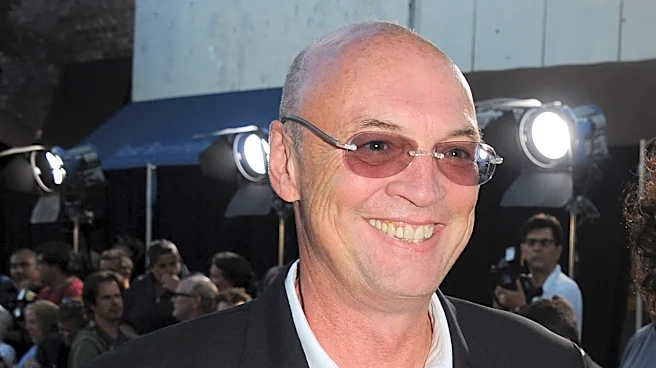
Moritz Borman, a renowned film producer known for his work on Oscar-nominated films and collaborations with director Oliver Stone, has died at the age of 71 in Munich. His death was confirmed by his longtime producing partners, Eric Kopeloff and Philip
Schulz-Deyle, who stated that Borman passed away from natural causes. Borman's career spanned over 25 feature films, including notable works such as 'The Quiet American' and 'Under the Volcano.' He was instrumental in producing films across various genres, from political thrillers to action blockbusters. Borman's collaborations with Oliver Stone included films like 'Alexander,' 'World Trade Center,' and 'Snowden.' His contributions to the 'Terminator' franchise, with films like 'Terminator 3: Rise of the Machines' and 'Terminator Salvation,' further cemented his status in the industry. Borman's final project was a legal drama directed by John Lee Hancock, featuring actors Jonathan Bailey, Lakeith Stanfield, and Laura Dern.
Why It's Important?
Moritz Borman's passing marks the end of an era for a producer who significantly influenced both independent and mainstream cinema. His ability to bridge creative and financial gaps between Europe and Hollywood helped shape the landscape of filmmaking. Borman's work with Oliver Stone on films that tackled historical and political themes brought critical acclaim and sparked discussions on the subjects they portrayed. His involvement in the 'Terminator' series contributed to the franchise's global success, impacting the science fiction genre. Borman's legacy is not only in the films he produced but also in the inspiration he provided to filmmakers and the industry at large. His death is a loss to the cinematic world, where his passion and integrity left a lasting impact.
What's Next?
The film industry will likely reflect on Moritz Borman's contributions and the void his passing leaves. His final film, a legal drama by John Lee Hancock, is anticipated to be released, potentially serving as a tribute to his enduring influence. The industry may also see retrospectives or tributes celebrating his work and the films he helped bring to life. As filmmakers and producers continue to navigate the evolving landscape of cinema, Borman's approach to bridging international film markets may serve as a model for future collaborations.
Beyond the Headlines
Moritz Borman's career highlights the importance of international collaboration in filmmaking. His ability to connect European and Hollywood markets not only expanded the reach of his films but also enriched the cultural narratives presented in cinema. Borman's work underscores the potential for film to serve as a medium for cross-cultural dialogue and understanding. His legacy may inspire future producers to pursue similar paths, fostering a more interconnected global film industry.