






What's Happening?
Intel has announced that its new 18A-P manufacturing process has entered the risk production phase, indicating a strategic move to cater to the growing demand for high-performance central processors, particularly for AI workloads. This development marks
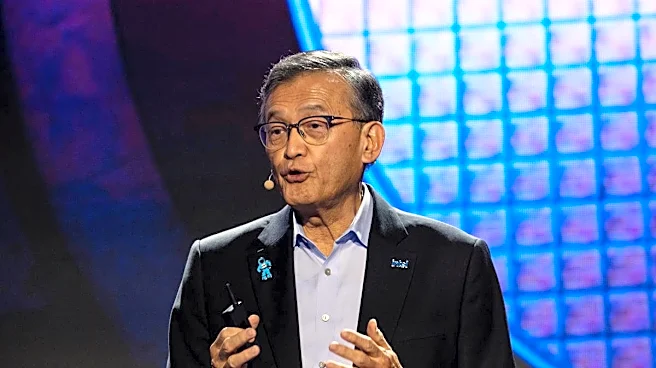
a significant step in Intel's manufacturing capabilities, as the 18A-P process offers approximately 9% higher performance at the same power level or 18% lower power consumption at the same processing speed compared to its predecessor, the 18A. The process also improves thermal characteristics and design flexibility, making it more appealing to external customers. Intel's CEO, Lip-Bu Tan, and CFO, David Zinsner, have highlighted the potential of 18A-P to attract external customers, reflecting a shift in the company's approach to its manufacturing processes. The demand for AI-oriented central processors has been robust, prompting Intel to sell previously written-off chips. The company projects its second-quarter revenue to be between $13.8 billion and $14.8 billion.
Why It's Important?
The introduction of the 18A-P process into risk production is a pivotal moment for Intel as it seeks to expand its customer base beyond internal use. This move could significantly enhance Intel's position in the competitive high-performance chip market, especially as demand for energy-efficient process technologies grows in response to the increasing interest in AI and neural networks. By offering improved performance and power efficiency, the 18A-P process aligns with the industry's shift towards more sustainable and efficient computing solutions. This development not only strengthens Intel's market position but also underscores the company's commitment to innovation and adaptation in a rapidly evolving technological landscape.
What's Next?
As Intel continues to advance its 18A-P process, the company is likely to focus on securing external customers and expanding its market share in the high-performance chip sector. The successful adoption of 18A-P by external clients could lead to increased revenue streams and further solidify Intel's reputation as a leader in semiconductor manufacturing. Additionally, the ongoing demand for AI and energy-efficient technologies may drive further innovations and enhancements in Intel's manufacturing processes, potentially leading to new product releases and partnerships in the future.