






What's Happening?
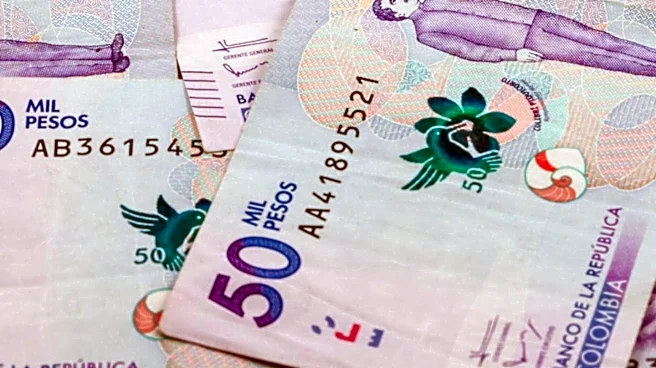
Colombia's central bank, Banco de la Republica (BanRep), has decided to keep its benchmark interest rate unchanged at 12.25% for November. This decision was reached by a majority vote during its October meeting. The central bank cited a marginal acceleration
in headline inflation as a key factor, alongside a moderation in core inflation. Additionally, indicators of economic activity have shown a weakening trend for the third quarter, characterized by lower consumption growth and subdued performance across productive sectors. The bank also highlighted the potential for the El Niño phenomenon to pose a significant upside risk to food and regulated inflation, primarily due to possible stress on the prices of perishable goods. The future trajectory of public finances and the Economic Rescue Law bill, currently under consideration in Congress, are central to upcoming monetary policy decisions.
Why It's Important?
The central bank's decision to hold interest rates steady reflects a cautious approach to managing Colombia's economy, balancing inflationary pressures with signs of an economic slowdown. For U.S. businesses and investors with interests in Colombia, this stability in interest rates could offer a degree of predictability in financial planning, though the underlying economic weakening suggests potential challenges in consumer demand and industrial output. The mention of the El Niño phenomenon as an inflationary risk is particularly important for agricultural commodity markets and related U.S. import businesses, as disruptions in food supply chains could impact prices. Furthermore, the emphasis on public finances and legislative developments underscores the interconnectedness of fiscal and monetary policy, indicating that political decisions in Colombia will have direct implications for its economic stability and attractiveness for foreign investment.
What's Next?
The central bank will continue to monitor economic indicators, with particular attention to inflation trends, the impact of the El Niño phenomenon on food prices, and the progress of the Economic Rescue Law bill through Congress. The passage of this legislation will be a key determinant for future interest rate decisions. Stakeholders, including businesses and investors, will be closely watching for any shifts in these factors, as they will influence the central bank's monetary policy stance. Any significant changes in inflation or economic growth could prompt BanRep to reconsider its current rate, potentially leading to either rate hikes to curb inflation or cuts to stimulate economic activity. The ongoing assessment of public finances will also play a crucial role in shaping the economic outlook.
Beyond the Headlines
The central bank's decision highlights a broader global challenge faced by many economies: navigating persistent inflation while simultaneously confronting signs of economic deceleration. This delicate balancing act can lead to prolonged periods of high interest rates, which, while intended to stabilize prices, can also stifle investment and consumer spending. The specific mention of the El Niño phenomenon introduces an external, climate-related variable that can significantly complicate economic forecasting and policy-making, demonstrating how environmental factors are increasingly intertwined with national economic stability. The interplay between the central bank's independence and the government's fiscal policies, particularly regarding the Economic Rescue Law, also raises questions about the autonomy of monetary policy in the face of political priorities and the potential for fiscal measures to either support or undermine monetary objectives.