







What's Happening?
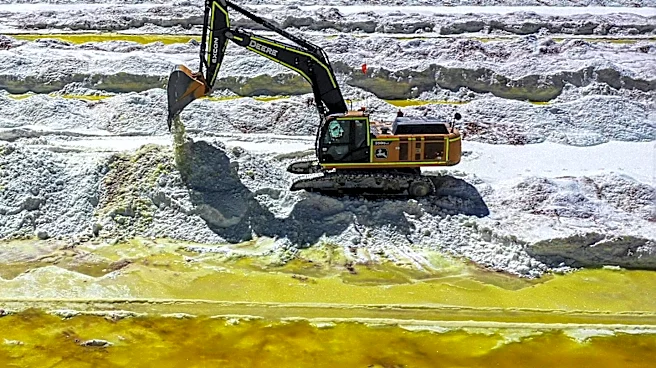
Rio Tinto, a major Anglo-Australian mining company, is evaluating a potential $1 billion investment for a new lithium plant in Argentina. This proposed facility, known as the Fenix II project, would be located in the Hombre Muerto salt flat in Catamarca
province. Chief Executive Simon Trott indicated that the company plans to submit this project to Argentina's incentive regime for large investments next year, with a final investment decision possibly occurring towards the end of the decade. This consideration follows the recent inauguration of two new lithium plants by Rio Tinto in the same region. Argentina is a key component of the 'Lithium Triangle,' which also includes Bolivia and Chile, collectively holding 60% of the world's lithium reserves—a critical material for electric vehicle batteries. Rio Tinto currently has a $4.4 billion investment pipeline in Argentina and is also exploring opportunities to advance copper projects within the country. This move aligns with President Javier Milei's administration, which is actively seeking to attract foreign investment through market-friendly reforms and tax incentives for large-scale projects.
Why It's Important?
This potential $1 billion investment by Rio Tinto underscores Argentina's growing significance in the global supply chain for electric vehicle components. The expansion of lithium production directly impacts the automotive industry, particularly in the U.S. and Europe, as manufacturers increasingly rely on lithium for EV battery production. A stable and expanding supply from Argentina could help diversify sourcing and potentially mitigate price volatility for this critical mineral. For Argentina, attracting such substantial foreign direct investment is crucial for economic growth, job creation, and solidifying its position as a key player in the global energy transition. The project also signals confidence in President Milei's economic policies, which aim to create a more favorable environment for international businesses. The development of these resources is vital for meeting the escalating global demand for renewable energy technologies and reducing reliance on fossil fuels.
What's Next?
Rio Tinto is expected to formally submit the Fenix II project to Argentina's incentive regime for large investments in the coming year. This submission will likely trigger a detailed review process by Argentine authorities, assessing the project's economic, environmental, and social impacts. A final investment decision from Rio Tinto is anticipated closer to the end of the decade, contingent on market conditions, regulatory approvals, and the overall economic stability of Argentina. Should the project proceed, it would involve significant construction and operational phases, creating numerous jobs and further integrating Argentina into the global lithium market. The success of this project could also encourage other international mining companies to increase their investments in Argentina, particularly in the lithium and copper sectors, further bolstering the country's mining industry and its role in the global energy transition.
Beyond the Headlines
The potential expansion of Rio Tinto's lithium operations in Argentina highlights broader geopolitical and environmental considerations. The 'Lithium Triangle' is becoming a strategic region for global powers and industries seeking to secure critical mineral supplies. This intensified focus on lithium extraction raises questions about sustainable mining practices, water usage in arid regions, and the impact on local communities. Ensuring that these large-scale projects adhere to stringent environmental and social governance (ESG) standards will be crucial for long-term viability and public acceptance. Furthermore, Argentina's efforts to attract foreign investment through market-friendly reforms could set a precedent for other resource-rich developing nations, influencing global investment trends and the competition for critical raw materials. The long-term implications include potential shifts in global economic power as countries with significant mineral reserves leverage their resources in the transition to a green economy.