



What's Happening?
Walmart is heavily investing in price reductions for consumers and expanding its e-commerce capabilities, as evidenced by its strong financial performance in the second quarter. For the three months ending July 31, 2026, the company reported a 5.9% increase
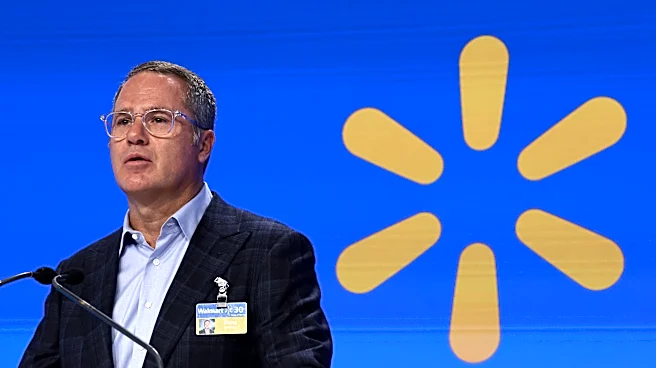
in revenue, reaching $187.9 billion, and a 28.8% jump in operating income. Global e-commerce sales grew by 23%, advertising revenue by 38%, and membership fee revenue by 17%. CEO John Furner emphasized the company's commitment to price investment, stating it is crucial for customers and drives market share gains. Despite these investments, Walmart maintains a conservative dividend payout, with free cash flow comfortably covering dividends in the last 10 fiscal years. The dividend payout ratio stood at 57% over the 12 months ending July 31, 2026. However, the company anticipates over $2 billion in additional fuel costs this year, which contributed to a $1.4 billion decrease in free cash flow for the first six months of the fiscal year, totaling $5.5 billion.
Why It's Important?
Walmart's strategy of investing heavily in price and e-commerce growth has significant implications for the U.S. retail landscape and consumer spending. By prioritizing lower prices, Walmart aims to attract and retain customers, potentially increasing its market share in a competitive retail environment. This approach can put pressure on other retailers to adjust their pricing strategies, benefiting consumers through more affordable goods. The substantial growth in e-commerce, advertising, and membership revenue indicates a successful diversification beyond traditional brick-and-mortar sales, positioning Walmart strongly in the evolving retail sector. The company's ability to maintain a healthy dividend payout while making these strategic investments signals financial stability, which is crucial for investors. However, the projected increase in fuel costs highlights external economic pressures that could impact profitability and operational efficiency across the retail industry.
What's Next?
Walmart is expected to continue its aggressive investment in pricing and digital expansion to further solidify its market position. The company's focus on e-commerce, advertising, and membership services suggests ongoing efforts to enhance its omnichannel retail experience. While the dividend payout remains conservative, allowing for significant reinvestment, the company will need to manage rising operational costs, particularly fuel expenses, which are projected to exceed $2 billion this year. This could lead to further optimization of supply chains and operational efficiencies to mitigate cost pressures. The continued emphasis on price leadership will likely influence consumer purchasing decisions and competitive dynamics within the U.S. retail sector, potentially driving other retailers to innovate or adjust their own strategies to compete effectively.
Beyond the Headlines
Walmart's sustained focus on price investment and e-commerce growth reflects a broader strategic response to evolving consumer behaviors and economic conditions. In an environment where consumers are increasingly value-conscious and reliant on digital shopping, Walmart's strategy aims to capture a larger share of both online and offline retail. This approach also highlights the increasing importance of diversified revenue streams, such as advertising and membership fees, for traditional retailers seeking to maintain growth. The company's ability to absorb significant cost increases, like fuel, while still investing in customer-centric initiatives, underscores its scale and operational prowess. This could set a precedent for how large retailers navigate inflationary pressures and technological shifts, emphasizing that long-term market share gains are often prioritized over short-term profit maximization in highly competitive sectors.