


What's Happening?
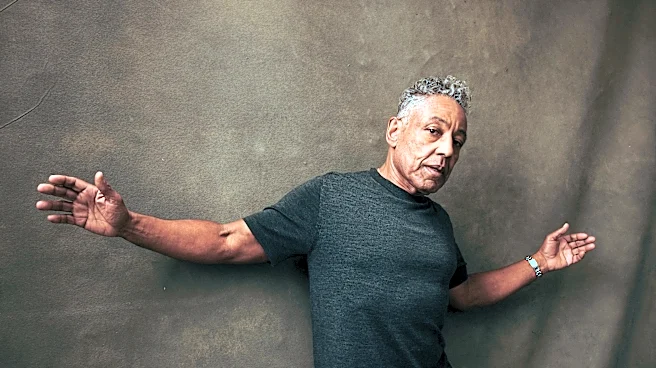
Giancarlo Esposito, known for his roles as Gus Fring in 'Breaking Bad' and Moff Gideon in 'The Mandalorian,' consistently projects a commanding presence despite being 5 feet 8 inches tall, which is slightly below the average height for an adult American
male. Directors and cinematographers frequently employ various techniques to enhance his on-screen stature, such as low-angle shots that elongate his figure and meticulously tailored wardrobe that creates vertical lines. Esposito's acting style, characterized by controlled movements, calm demeanor, and intense eye contact, allows him to convey dominance and authority without relying on physical size. This is evident in his performances where he often shares scenes with taller co-stars, including Bryan Cranston (5'11"), yet manages to appear equally, if not more, imposing.
Why It's Important?
This phenomenon challenges traditional casting norms in Hollywood, which often favor physically imposing actors for villainous or authoritative roles. Esposito's success demonstrates that psychological intensity, nuanced acting, and strategic cinematography can be more effective in conveying power than sheer physical height. This has significant implications for actors who may not fit conventional physical molds, opening doors for a wider range of talent to be considered for diverse roles. For the film and television industry, it highlights the power of visual storytelling and directorial choices in shaping audience perception, proving that perceived stature can be manipulated through artistic techniques. It also underscores the importance of an actor's craft in creating memorable and impactful characters, regardless of their physical attributes.
What's Next?
The continued success of actors like Giancarlo Esposito could lead to a broader re-evaluation of casting criteria in Hollywood, potentially encouraging more diverse physical types in roles traditionally reserved for taller or more physically imposing individuals. This shift could foster greater creativity in character development and visual direction, as filmmakers explore innovative ways to convey power and presence. Audiences may also become more attuned to the subtle techniques used in filmmaking to shape their perceptions of characters, enhancing their appreciation for the artistry involved. Esposito's ongoing career will likely serve as a benchmark for how actors can leverage their talent and screen presence to overcome physical expectations, influencing future generations of performers and directors.
Beyond the Headlines
Giancarlo Esposito's ability to project dominance despite his average height delves into the psychology of perception and authority. His performances illustrate that true power on screen often stems from internal qualities—such as unwavering confidence, intellectual prowess, and psychological manipulation—rather than purely physical attributes. This challenges societal biases that often equate physical size with strength or authority. Ethically, it promotes a more inclusive view of what constitutes a powerful figure, moving beyond superficial characteristics. Culturally, it reinforces the idea that charisma and talent can transcend physical limitations, offering a compelling narrative about the nature of influence and intimidation. His work serves as a masterclass in how an actor can command a scene through sheer force of will and meticulous craft, making him a significant figure in contemporary acting.