





What's Happening?
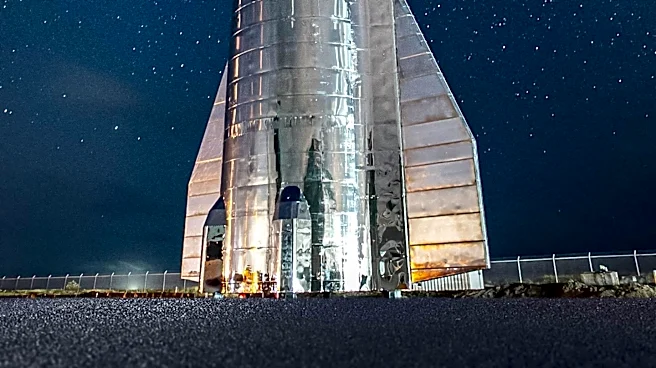
Goldman Sachs and Apollo Global Management are marketing slices of a roughly $40 billion debt package to finance the purchase of Nvidia chips for SpaceX's AI data centers. This deal, structured as a master finance lease, aims to fund SpaceX's expansion
into AI cloud services, with the chips to be rented by SpaceX. Elon Musk has expressed skepticism about lending to companies solely focused on AI data centers, but this deal is structured to allow lenders to count on all of SpaceX's assets, including Starlink and launch services, to secure the debt. SpaceX's AI segment already accounts for more than half of its third-quarter sales, and analysts project its total revenue to reach $336 billion by 2028, largely driven by its AI and connectivity businesses. The Nvidia Rubin chips, valued at approximately $47.3 billion, are expected to be delivered in the first half of 2027.
Why It's Important?
This significant debt financing highlights SpaceX's aggressive expansion into the artificial intelligence sector, diversifying its revenue streams beyond space launches and satellite internet. For the U.S. business landscape, this move signifies the increasing convergence of space technology and AI, with major financial institutions like Goldman Sachs and Apollo facilitating large-scale investments in this emerging hybrid market. The deal's structure, leveraging all of SpaceX's assets, underscores the perceived value and stability of its core businesses, particularly Starlink, in securing such substantial financing. This investment could accelerate the development of advanced AI capabilities within the U.S., impacting various sectors from defense to commercial applications. It also reflects the intense demand for high-performance computing resources, particularly Nvidia chips, to power AI advancements.
What's Next?
The successful marketing of this $40 billion debt package will enable SpaceX to significantly scale its AI data center operations, acquiring a large number of Nvidia Rubin chips. This expansion is expected to further boost SpaceX's AI segment revenue, contributing substantially to its projected growth. The deal's outcome will also be closely watched by investors and analysts to gauge market confidence in 'neocloud' companies and the broader AI infrastructure sector. The reliance on SpaceX's entire business for collateral suggests a cautious approach by lenders, indicating that the financial health of its space and connectivity divisions remains crucial. The performance of these AI data centers and their ability to attract and retain major customers, such as Anthropic, will be key determinants of the investment's success.
Beyond the Headlines
This financing deal reveals a fascinating tension between Elon Musk's stated skepticism about 'pure AI clouds' and SpaceX's strategic pivot into this very domain. The structure of the debt, which ties the AI venture to the financial stability of Starlink and launch services, suggests a pragmatic approach to risk management in a rapidly evolving technological landscape. It raises questions about the long-term sustainability of such massive investments in AI infrastructure and the potential for market consolidation among 'neocloud' providers. Furthermore, the deal highlights the immense capital requirements for developing cutting-edge AI, underscoring the critical role of financial markets in shaping technological progress. The ethical implications of a single company, with significant influence in space and AI, accumulating such vast computing power also warrant consideration, particularly regarding data privacy, algorithmic bias, and potential monopolistic tendencies.