
What's Happening?
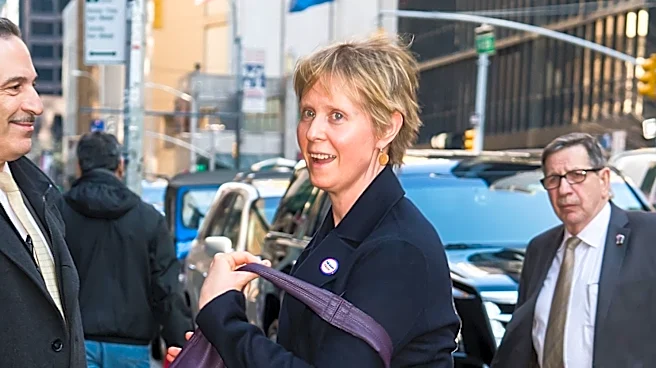
Cynthia Nixon, known for her role as Miranda Hobbes in 'Sex and the City,' recently appeared on 'The Drew Barrymore Show' to discuss her return to the franchise with the HBO series 'And Just Like That…'.
During her appearance, Nixon addressed the past criticisms regarding the original 'Sex and the City' series being 'overwhelmingly white.' She indicated that the creators and cast aimed to 'fix' this issue in the new iteration of the show. This discussion comes as 'And Just Like That…' has introduced more diverse characters and storylines, reflecting a conscious effort to broaden the representation within the beloved franchise. Nixon's comments highlight the ongoing conversation in Hollywood about the importance of diversity and inclusion in media productions, particularly for long-running and influential series.
Why It's Important?
Cynthia Nixon's remarks are significant as they acknowledge and address a long-standing critique of 'Sex and the City,' a show that has had a substantial cultural impact. By openly discussing the original series' lack of diversity, Nixon contributes to a broader industry dialogue about representation and the responsibility of creators to reflect a more inclusive society. This public acknowledgment from a prominent cast member can influence audience perceptions and encourage other productions to critically evaluate their own diversity efforts. For viewers, especially those from underrepresented communities, this shift towards more inclusive storytelling can foster greater connection and relevance with the series, potentially expanding its audience base and cultural longevity. It also signals a commitment from the show's creators to evolve with contemporary societal values.
What's Next?
The ongoing discussion about diversity in 'And Just Like That…' suggests that future seasons, if produced, will likely continue to prioritize and expand upon the show's efforts to be more inclusive. This could involve introducing more characters from diverse backgrounds, exploring a wider range of cultural experiences, and addressing contemporary social issues through its storylines. The public conversation initiated by Nixon and others may also prompt further critical analysis from media outlets and academic circles regarding the effectiveness and authenticity of these diversity initiatives. For the entertainment industry as a whole, such discussions often lead to increased pressure on studios and networks to implement more comprehensive diversity policies in casting, writing, and production roles, potentially setting new benchmarks for representation in mainstream media.
Beyond the Headlines
The conversation surrounding 'Sex and the City' and its evolution towards greater diversity touches upon deeper societal shifts regarding identity, representation, and cultural narratives. The original series, while groundbreaking in its portrayal of female friendships and sexuality, has been retrospectively critiqued for its narrow demographic focus. The conscious effort to diversify in 'And Just Like That…' reflects a broader cultural reckoning where audiences demand to see themselves and their experiences reflected in media. This shift is not merely about adding diverse faces but about fundamentally re-evaluating who gets to tell stories and whose stories are told. It highlights the ethical imperative for media to represent the multifaceted reality of society, moving beyond tokenism to genuine integration and authentic storytelling, which can influence societal perceptions and foster greater understanding and empathy among diverse groups.