






What's Happening?
Morgan Stanley has issued a warning regarding the financial sustainability of the artificial intelligence boom, stating that it is entering a more capital-intensive phase. The investment bank highlights a growing financing gap for major hyperscalers such
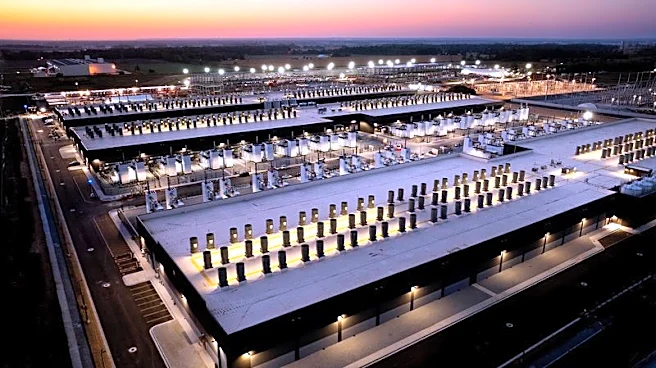
as Microsoft, Alphabet, Amazon, and Meta Platforms. Morgan Stanley projects that the combined capital expenditures for these four companies will increase by 57% in 2027 compared to 2026, as they accelerate efforts to build data centers, enhance computing capacity, and develop power infrastructure. While the bank believes that AI investments can yield returns on invested capital exceeding 25%, the primary challenge lies in the timing: AI infrastructure demands significant upfront cash, whereas revenue and free cash flow are realized later. This discrepancy has led to a continuous decline in Morgan Stanley's 2027 free-cash-flow estimates for these hyperscalers, creating a widening financing gap.
Why It's Important?
This warning from Morgan Stanley is crucial for investors and the broader U.S. economy, as it highlights potential financial strains within the rapidly expanding AI sector. The escalating capital expenditure requirements for AI infrastructure could impact the financial health of some of the largest technology companies, potentially affecting their stock performance and overall market stability. The widening financing gap suggests that these companies may need to explore alternative funding mechanisms or face increased borrowing costs, as evidenced by the widening credit spreads for hyperscaler debt. This situation could also create a divide between cash-rich companies like Nvidia and Broadcom, which have greater financing flexibility, and those further down the credit spectrum, such as Oracle and data-center developers, who may be more vulnerable to rising interest rates. The need for substantial upfront investment in AI infrastructure also has implications for the pace of technological advancement and the competitive landscape within the AI industry.
What's Next?
Investors will need to closely monitor the upcoming hyperscaler earnings cycles, focusing not just on AI revenue growth but also on 2027 capital expenditure guidance, free-cash-flow revisions, financing activities, and management commentary regarding AI returns. The ability of these companies to demonstrate that AI revenue and utilization are increasing sufficiently to offset accelerating depreciation, power costs, and financing needs will be critical. Evidence that returns on invested capital remain above Morgan Stanley's 25% threshold will be essential to strengthen investment cases. Furthermore, the evolution of credit spreads, particularly for Oracle and leveraged infrastructure operators, will be a key indicator, as persistent widening could slow deployment or necessitate higher required returns. The market may also see an increase in private capital and asset-backed structures being used to fund servers, chips, and energy infrastructure, as companies seek diverse financing solutions for their AI ambitions.
Beyond the Headlines
The challenges highlighted by Morgan Stanley extend beyond immediate financial metrics, touching upon the fundamental economics of the AI revolution. The massive capital outlays required for AI infrastructure raise questions about the long-term sustainability of current growth trajectories and the potential for market consolidation. Companies with deeper pockets and more robust financing options may gain a significant competitive advantage, potentially leading to a more concentrated AI industry. This situation also underscores the critical role of financial innovation in supporting technological advancement, as new financing models, such as those involving private capital and asset-backed structures, become increasingly vital. The need for substantial power infrastructure also brings environmental and regulatory considerations to the forefront, as the energy demands of large-scale AI data centers continue to grow, potentially impacting energy markets and climate goals.