





What's Happening?
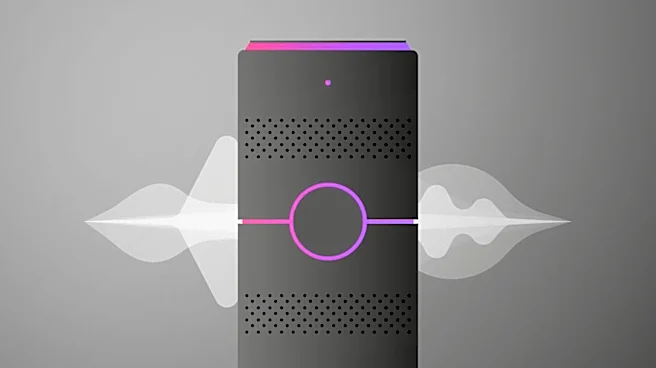
Sonos has announced two versions of its voice control system: Classic Sonos Voice Control (Classic SVC) and Sonos 27voice. Classic SVC processes voice commands entirely on the device, ensuring no audio, transcript, or voice data is transmitted to Sonos servers
or third parties. It supports a fixed set of playback and device control commands. In contrast, Sonos 27voice is an optional upgrade that utilizes AI in the cloud to understand a broader range of commands, including open-ended questions. After wake-word activation, voice commands for Sonos 27voice are transmitted to Sonos cloud infrastructure for AI processing, encrypted in transit. Sonos 27voice is initially available in English only, with potential future expansion to other languages. Users can choose which version to activate or disable either at any time via the Sonos app or a hardware mute button.
Why It's Important?
The introduction of Sonos 27voice signifies a major step for Sonos into advanced AI integration, offering users a more sophisticated and flexible way to interact with their home audio systems. This move could enhance user experience by allowing for more natural language commands and open-ended queries, potentially making smart home control more intuitive. For consumers, the choice between on-device processing (Classic SVC) and cloud-based AI (Sonos 27voice) provides flexibility based on their preferences for privacy and functionality. The AI-assisted cloud processing, while offering advanced capabilities, also introduces considerations regarding data transmission and privacy, which Sonos addresses by allowing users to opt-in and providing transparency about AI interaction. This development reflects a broader industry trend towards integrating more powerful AI into consumer electronics.
What's Next?
Sonos may expand Sonos 27voice to additional languages in the future, though no commitment has been made. The company reserves the right to define, adjust, and limit the scope of open-ended AI responses for reasons such as cost management, quality, legal compliance, safety, and abuse prevention. Limitations on open-ended responses may include temporary throttling, temporary loss of availability, category restrictions, ongoing usage caps, or structural reduction of capability, with varying notice periods for users. However, these limitations will not affect Sonos 27voice's core audio control functionality. Users can revert to Classic SVC if they do not wish to continue using Sonos 27voice under any revised scope. Sonos also implements machine-readable marking of Sonos 27voice audio outputs to identify them as AI-generated, in accordance with EU AI Act regulations.
Beyond the Headlines
The dual-version approach to voice control by Sonos highlights the ongoing tension between advanced AI functionality and user privacy concerns. By offering an on-device processing option, Sonos caters to users who prioritize data privacy, while the cloud-based AI option appeals to those seeking more advanced and flexible interactions. This strategy could become a model for other tech companies navigating similar challenges. The explicit AI disclosure and compliance with regulations like the EU AI Act underscore the increasing importance of transparency and ethical considerations in AI development. The potential for AI to generate content and interpret complex commands also raises questions about the accuracy and reliability of such systems, as Sonos acknowledges that errors are inherent to current AI technology. This transparency is crucial for building user trust in evolving AI-powered products.