



What's Happening?
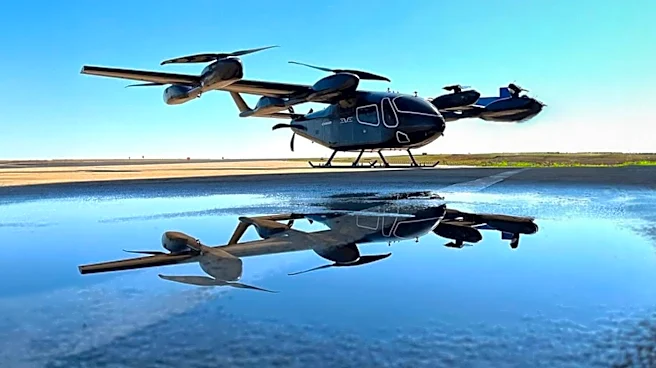
Eve Air Mobility has successfully completed its first partial transition flight for its electric vertical takeoff and landing (eVTOL) aircraft. This milestone marks a significant step in the development of Eve's eVTOL program, as it involved the activation
of the aircraft's rear pusher propeller, transitioning from vertical lift to wing-borne flight. The test flight achieved a stabilized speed of 27 knots and a maximum ground speed of 30 knots, reaching a height of 90 feet above ground level. The flight lasted 3 minutes and 9 seconds, covering approximately 0.84 nautical miles. This achievement is crucial for validating the design and performance of Eve's eVTOL aircraft, as stated by Johann Bordais, CEO of Eve Air Mobility.
Why It's Important?
The successful transition flight is a pivotal development in the urban air mobility sector, which aims to revolutionize transportation by introducing efficient and scalable air mobility solutions. Eve Air Mobility's progress in eVTOL technology could significantly impact the future of urban transportation, offering a sustainable alternative to traditional ground transport. This advancement not only positions Eve as a leader in the emerging eVTOL market but also supports the broader goal of reducing urban congestion and emissions. The data collected from this flight will aid in further expanding the aircraft's capabilities, potentially influencing regulatory frameworks and infrastructure development for urban air mobility.
What's Next?
Eve Air Mobility plans to continue its flight-testing program, focusing on expanding the aircraft's airspeed envelope and conducting more complex transition flight tests. The company will also perform datalink testing to validate radio link performance at higher speeds. These steps are essential for achieving full certification and commercial deployment of the eVTOL aircraft. As the program progresses, Eve will likely engage with regulatory bodies and urban planners to address the challenges of integrating eVTOLs into existing airspace and urban environments.