




What's Happening?
Chicago Federal Reserve President Austan Goolsbee has issued a warning regarding the persistent nature of inflation in the U.S., describing the latest inflation report as 'distressing' and 'borderline disturbing.' According to Goolsbee, services inflation is not
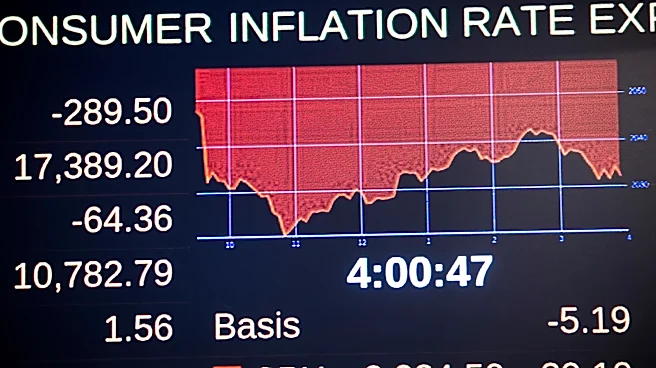
decreasing as anticipated, and several cost-driving factors that were expected to dissipate have continued. The Consumer Price Index (CPI) increased by 0.4% in October, following a 0.6% rise in September, with shelter costs contributing over 30% of the monthly increase, food prices rising by 0.5%, and energy prices climbing by 0.7%. The Philadelphia Fed's Survey of Professional Forecasters projects headline CPI inflation at a 4% annualized rate for the fourth quarter. Goolsbee highlighted that the ongoing high inflation rates are impacting real people, citing an example of an Illinois farmer who sent him a diesel pump to illustrate the burden of rising costs.
Why It's Important?
Goolsbee's concerns underscore a critical challenge for the U.S. economy and its citizens: the erosion of purchasing power due to sustained inflation. His remarks suggest that the Federal Reserve's efforts to bring inflation down to its 2% target are not yet yielding the desired results, particularly in the services sector. This persistence in inflation directly impacts American households, as the cost of living continues to rise, making it harder for savers to maintain the value of their nest eggs. If interest rates on savings accounts fail to keep pace with inflation, the real value of money diminishes over time. The situation also poses a dilemma for the Federal Reserve, as continued high inflation could necessitate further monetary policy adjustments, potentially impacting economic growth and employment. The warning from a prominent Fed official signals that the economic landscape remains challenging, with implications for investment strategies and financial planning across the country.
What's Next?
The Federal Reserve will likely continue to closely monitor inflation data, particularly services inflation, to determine future monetary policy actions. Goolsbee's assessment suggests that the path back to 2% inflation is not yet clear, implying that the Fed may need to maintain a cautious stance on interest rates. Consumers and businesses should prepare for the possibility of continued elevated prices and potentially higher borrowing costs. The ongoing inflation could also prompt a re-evaluation of investment strategies, with some experts suggesting a focus on assets that historically perform well during inflationary periods, such as gold or real estate. The Fed's next decisions will be crucial in shaping the economic outlook, and stakeholders will be watching for any indications of a shift in policy or a clearer trajectory for inflation.
Beyond the Headlines
The prolonged battle against inflation highlighted by Goolsbee reveals deeper structural issues within the U.S. economy. The expectation that certain cost drivers would be 'transitory' has proven incorrect, suggesting that the underlying causes of inflation may be more complex and entrenched than initially thought. This situation could lead to a re-evaluation of economic models and forecasting methods used by policymakers. Furthermore, the impact on 'real people,' such as the Illinois farmer, underscores the social and political dimensions of inflation, as it can disproportionately affect different segments of the population and lead to public discontent. The challenge for the Fed extends beyond mere economic indicators to maintaining public trust and ensuring economic stability for all Americans. The current environment also prompts a broader discussion about the long-term implications of monetary policy on wealth distribution and economic equity.