







What's Happening?
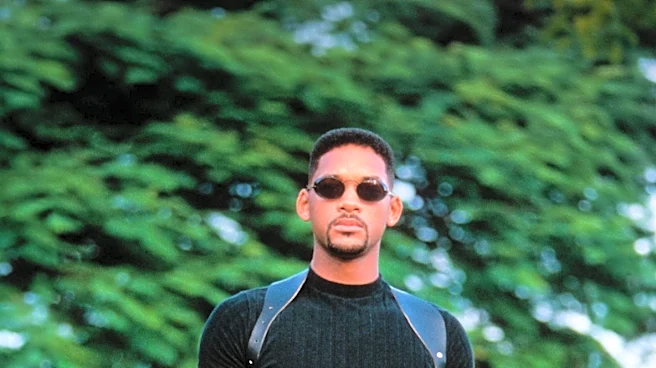
Will Smith was the initial choice for the lead role of Neo in 'The Matrix,' the groundbreaking science fiction trilogy. However, Smith turned down the role, citing his inability to fully grasp the story, the vision, or the character at the time. He expressed
concerns that he would not be able to give the role the respect it deserved. Instead of starring in 'The Matrix,' Smith chose to appear in 'Wild Wild West,' a film that subsequently became known as one of the most significant critical and financial failures of his career. This decision is often highlighted as a notable instance of an actor passing on a role that went on to become iconic, with the alternative choice proving to be a major misstep in their filmography.
Why It's Important?
This decision by Will Smith is significant as it illustrates the unpredictable nature of Hollywood success and the challenges actors face in selecting roles. 'The Matrix' went on to become a cultural phenomenon, redefining the sci-fi genre and cementing Keanu Reeves' status as a global star. Smith's choice to instead star in 'Wild Wild West,' a film widely panned by critics and a box office disappointment, represents a pivotal moment that could have drastically altered his career trajectory and the landscape of cinematic history. It underscores how a single decision can have profound long-term implications for an actor's legacy and the films themselves, demonstrating that even established stars can misjudge the potential of a script or project. The story also highlights the subjective nature of creative vision and how a lack of understanding can lead to missed opportunities.
What's Next?
While this event is historical, its implications continue to resonate in discussions about iconic film roles and career choices. For Will Smith, the decision remains a frequently cited example in interviews and retrospectives about his career, often prompting reflection on 'what if' scenarios. For the film industry, it serves as a cautionary tale about the difficulty of predicting a project's success and the importance of an actor's connection to the material. Future discussions about actors turning down major roles will likely continue to reference Smith's decision regarding 'The Matrix' as a prime example. It also contributes to the ongoing narrative of how certain roles become inextricably linked with the actors who ultimately portray them, making it difficult to imagine anyone else in those parts.
Beyond the Headlines
The story of Will Smith turning down 'The Matrix' delves into deeper themes of artistic intuition, risk assessment, and the pressure on actors to make career-defining choices. It raises questions about whether an actor's personal understanding of a script is paramount, or if trusting a director's vision, even when unclear, can sometimes lead to greater success. The contrast between the philosophical depth of 'The Matrix' and the more lighthearted, albeit ultimately unsuccessful, 'Wild Wild West' also speaks to the different types of projects actors are drawn to. This decision highlights the subjective nature of art and the fact that even highly successful individuals can misjudge cultural shifts or groundbreaking concepts. It also contributes to the lore of Hollywood, where such 'missed opportunities' become legendary tales that shape how audiences and industry insiders perceive the careers of major stars.