





What's Happening?
A new book, 'Science Fiction Ecologies: Worldmaking with Butler, Le Guin, and Merril' by Shelley Streeby, delves into how Ursula K. Le Guin channeled her environmentalism, pacifist anarchist feminism, and anti-Vietnam War activism into her speculative
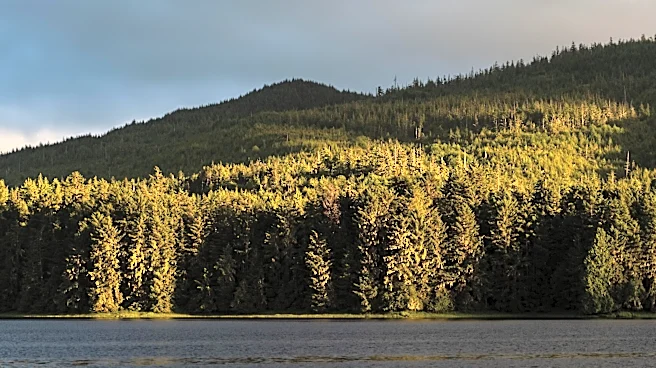
fiction during the 1960s and 1970s. Le Guin's works, such as 'A Wizard of Earthsea' (1968), 'The Left Hand of Darkness' (1969), 'The Word for World is Forest' (1972), and 'The Dispossessed' (1974), are highlighted for their exploration of environments, ecologies, gender, race, and sexuality. The book emphasizes Le Guin's deep connection to the landscapes of California and Oregon, where she grew up and lived, and how these places inspired her imagined worlds and critical perspectives on state violence and techno-fix thinking.
Why It's Important?
This exploration of Ursula K. Le Guin's work is significant because it underscores the enduring relevance of her themes in contemporary discussions about climate change, social justice, and alternative societal structures. Le Guin's pioneering approach to integrating environmental concerns with feminist and anarchist philosophies in science fiction provided a powerful framework for imagining different futures. Her critiques of colonialism, as seen in 'The Word for World is Forest,' and her exploration of non-hierarchical societies in 'The Dispossessed,' offer valuable insights into current global challenges. By highlighting her connection to specific U.S. landscapes, the book also emphasizes how local environments can inspire universal narratives, making her work particularly resonant for American readers grappling with environmental and social issues.
What's Next?
Shelley Streeby's book is available from NYU Press, offering readers a deeper understanding of Le Guin's literary contributions and their ecological underpinnings. The continued academic and public interest in Le Guin's work suggests that her influence will persist, particularly as environmental and social justice issues become more pressing. This analysis could inspire new generations of writers and activists to engage with speculative fiction as a tool for social commentary and world-building. Furthermore, the focus on Le Guin's regional inspirations might encourage a re-examination of how American landscapes and local histories shape broader literary and philosophical movements, fostering a more nuanced appreciation of the origins of influential ideas.
Beyond the Headlines
Le Guin's ability to weave complex ecological and social themes into compelling narratives offers a profound 'Beyond the Headlines' perspective. Her work challenges the anthropocentric view of the world, suggesting that human existence is deeply intertwined with, and dependent on, the natural environment. By creating worlds where gender is fluid ('The Left Hand of Darkness') or where societies operate without traditional state power ('The Dispossessed'), Le Guin invites readers to question fundamental assumptions about human nature and societal organization. Her emphasis on the interconnectedness of all living things and her critique of exploitative systems provide a powerful ethical framework for addressing contemporary crises. This deep engagement with environmental and social justice through fiction serves as a testament to the transformative power of literature in shaping consciousness and inspiring alternative visions for the future.