







What's Happening?
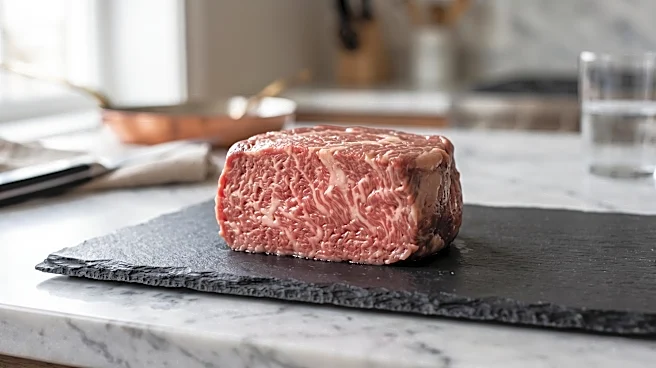
Researchers in South Korea, led by Professor Ju Seon-tae of Gyeongsang National University, have developed a hybrid cultivated steak that mimics sirloin and tenderloin, achieving a 70 to 80 percent reduction in production costs. This innovation combines
cultured animal muscle cells with plant proteins such as pea, soy, and wheat. The mixture is spun into thread-like fibers and bundled into a three-dimensional cut, with vegetable oils and beef tallow providing fat and marbling. The use of plant proteins provides the structural frame for the steak, and the researchers credit the reuse of cell-culture scaffolds for much of the cost savings. This development addresses a significant challenge in cultivated meat production: reproducing the complexity of real tissue, which typically requires extensive blood vessel networks for growth. The project was funded by Korea’s agriculture ministry and its food technology agency, IPET. If commercialized, the product is projected to sell for approximately ₩40,000 per kilogram, roughly half the price of grade-one Hanwoo sirloin.
Why It's Important?
This breakthrough in hybrid cultivated meat production holds significant implications for the U.S. food industry and consumers. The substantial reduction in production costs, estimated at 70 to 80 percent, could make cultivated meat more economically viable and accessible. Currently, high production costs are a major barrier to the widespread adoption of cultivated meat. By integrating plant-based proteins and reusing cell-culture scaffolds, the South Korean team offers a model for lowering expenses, which could accelerate research and development in the U.S. This approach could also appeal to a broader consumer base, including those seeking more sustainable and ethical meat alternatives without the premium price tag often associated with fully cultivated products. For U.S. businesses in the alternative protein sector, this could spur innovation in hybrid product development, potentially leading to new market opportunities and competitive advantages. Furthermore, it could contribute to food security by offering a more efficient and less resource-intensive method of meat production.
What's Next?
The cultivated steak product will require approval from Korea’s Ministry of Food and Drug Safety before it can be sold commercially. A startup, Orange Cow, has been spun out of the lab to further develop the product and navigate the regulatory process. The researchers' claims, however, are currently based on their own findings and those of their funder, rather than a peer-reviewed paper. Details such as the exact proportion of animal cells, the species from which the cells are derived, and specific tasting results have not yet been released. Future steps will likely involve rigorous testing, including sensory evaluations and nutritional analyses, to validate the product's quality and safety. If successful in Korea, this hybrid approach could influence regulatory frameworks and investment in cultivated meat technologies globally, including in the U.S., as companies seek to replicate cost-saving strategies and bring similar products to market.
Beyond the Headlines
The development of hybrid cultivated meat raises deeper questions about consumer perception, labeling, and the future of food. While the cost reduction is a significant step towards commercial viability, the hybrid nature of the product—combining animal cells with plant proteins—may necessitate clear and transparent labeling to inform consumers. This could lead to new categories and definitions within the alternative protein market, distinguishing between fully cultivated, hybrid, and purely plant-based products. Ethically, the hybrid approach might offer a compromise for consumers who are hesitant about fully lab-grown meat but are open to reducing their reliance on traditional animal agriculture. Legally, regulatory bodies in the U.S. and other countries will need to establish clear guidelines for the production, safety, and labeling of such hybrid foods, potentially influencing trade and international food standards. This innovation also highlights a broader trend towards diversified protein sources and the increasing integration of biotechnology into food production, signaling a long-term shift in how meat is conceived, produced, and consumed.