





What's Happening?
Senator Atiku Bagudu, Nigeria's Minister of Budget and Economic Planning, announced that President Bola Tinubu is working towards transforming Nigeria into a $2 trillion economy. Bagudu made this statement on Tuesday at the launch of the All Progressives
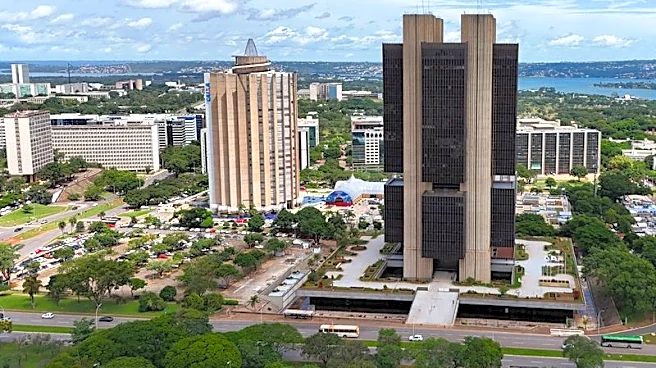
Congress (APC) manifesto for the presidential election, titled 'From Reform To Prosperity' agenda 2027 – 2031. The Minister emphasized President Tinubu's conviction that Nigeria possesses the human and material resources to achieve an economic scale comparable to or greater than Brazil's current $2 trillion economy. Bagudu highlighted that President Tinubu's approach is driven by the belief that sustainable prosperity requires bold reforms, prioritizing the country's economic footing over immediate political consequences. He acknowledged that significant work remains to ensure the benefits of these reforms translate into improved living conditions for ordinary Nigerians, particularly hardworking citizens, young people, and vulnerable groups. Bagudu also noted President Tinubu's political courage in making difficult economic decisions, even when they attract criticism and impose temporary hardship.
Why It's Important?
Minister Bagudu's announcement of President Tinubu's ambition to build a $2 trillion economy for Nigeria signifies a bold and ambitious economic vision for the nation. This goal, if achieved, would position Nigeria as a major economic power, significantly impacting its regional and global standing. The emphasis on bold reforms and prioritizing long-term economic stability over short-term political gains suggests a strategic approach to governance, aiming for fundamental structural changes. However, the acknowledgment that the benefits of these reforms have yet to fully reach ordinary Nigerians highlights a critical challenge: ensuring inclusive growth and mitigating the immediate hardships caused by economic adjustments. The success of this vision hinges on effective policy implementation, attracting investments, and improving the welfare of citizens. This economic trajectory could lead to increased foreign direct investment, job creation, and improved infrastructure, but it also carries the risk of social unrest if the reforms are not managed carefully and their benefits are not widely distributed. The comparison to Brazil's economy sets a clear benchmark for Nigeria's aspirations.
What's Next?
The 'From Reform To Prosperity' agenda 2027 – 2031, outlined in the APC manifesto, will likely guide President Tinubu's economic policies and initiatives in the coming years. The government is expected to continue implementing reforms aimed at stimulating economic growth, attracting investment, and improving the business environment. Efforts will likely focus on sectors identified as key drivers of economic expansion, with a continued emphasis on ensuring that the benefits of growth are felt by a broader segment of the population. The administration will need to address the concerns about the rising cost of living and unemployment to maintain public support for its reform agenda. The upcoming 2027 presidential election will serve as a critical juncture, where the electorate will assess the progress made towards this ambitious economic vision. The government's ability to demonstrate tangible improvements in the lives of ordinary Nigerians will be crucial for securing continued political mandate and achieving its long-term economic goals.
Beyond the Headlines
President Tinubu's aspiration for a $2 trillion Nigerian economy extends beyond mere economic figures; it represents a profound shift in national ambition and self-perception. By setting such a high benchmark, the administration is challenging the traditional narratives of Nigeria's economic potential and aiming to inspire a collective national effort towards prosperity. This vision implicitly acknowledges the country's vast human and natural resources, suggesting a belief that with the right policies and leadership, Nigeria can overcome its current economic challenges. However, the pursuit of such an ambitious goal also raises questions about the sustainability of growth, the equitable distribution of wealth, and the potential for increased inequality if reforms are not carefully managed. The emphasis on 'bold reforms' often implies difficult decisions that can have significant social and political ramifications. This long-term economic strategy will require not only sound fiscal and monetary policies but also robust institutional frameworks, good governance, and a commitment to transparency to ensure that the benefits of a larger economy translate into genuine improvements in the quality of life for all Nigerians.