







What's Happening?
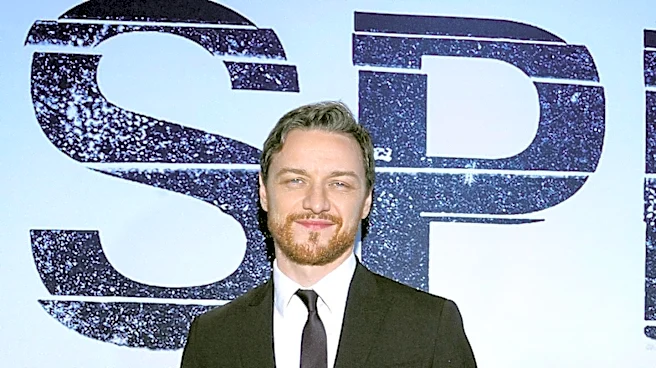
Actor James McAvoy has disclosed that among his extensive filmography, the 2016 thriller 'Split' is the only movie that consistently provides him with significant residual payments. This revelation came during his appearance on Josh Horowitz's 'Happy
Sad Confused' podcast, where he was promoting his directorial debut, 'California Schemin'.' McAvoy noted that while back-end deals are common in actor contracts, he rarely sees substantial payouts from them. He explained that 'Split' was made with a budget of approximately six million dollars, and after an estimated 30 million dollars in advertising, it generated 40 million dollars in its opening weekend, immediately turning a profit. This rapid profitability led to his first residual check arriving at the end of the first weekend, a situation he described as 'bonkers.' He clarified that other major films he has starred in, including the 'X-Men' series, do not offer the same consistent financial returns.
Why It's Important?
This insight from James McAvoy highlights a significant aspect of the film industry's financial structure, particularly concerning actor compensation beyond initial salaries. Residuals, which are payments made to actors and other crew members for the reuse of their work, are often a point of contention and negotiation in Hollywood. McAvoy's experience with 'Split' demonstrates that films with a high return on investment, especially those with relatively low production costs and strong box office performance, can generate substantial and consistent residual income for participants. This contrasts with larger-budget productions, even successful ones like the 'X-Men' franchise, where the distribution of profits and subsequent residual payments might be more complex or diluted. The revelation underscores the financial realities for many actors, where consistent residual income is not a given, and often depends on specific contractual terms and a film's financial success metrics.
What's Next?
The discussion around actor residuals, particularly in the context of streaming services and evolving distribution models, is an ongoing conversation within the entertainment industry. McAvoy's comments may further fuel debates regarding fair compensation for talent in an era where content is consumed across various platforms. While his statement is a personal anecdote, it contributes to a broader understanding of how different types of film projects can impact an actor's long-term earnings. Future negotiations between studios and talent guilds will likely continue to address the structure and consistency of residual payments, especially as the industry adapts to new technologies and consumption habits. Actors and their representatives may use such examples to advocate for more transparent and equitable residual structures in future contracts.
Beyond the Headlines
McAvoy's candidness sheds light on the often-opaque financial mechanisms of Hollywood, particularly the disparity in residual earnings across different projects. It challenges the public perception that all successful films automatically translate into continuous financial windfalls for their stars. The 'bonkers' nature of 'Split's' immediate profitability and subsequent residual payments suggests that smaller, high-impact films can sometimes offer more direct and immediate financial benefits to actors than blockbuster franchises. This situation also implicitly touches upon the broader economic shifts in the film industry, where the rise of independent and mid-budget films, if successful, can create more favorable residual conditions compared to the complex financial structures of tentpole productions. It also highlights the importance of understanding the specific financial terms of contracts, as not all box office success translates equally into an actor's personal earnings.