


What's Happening?
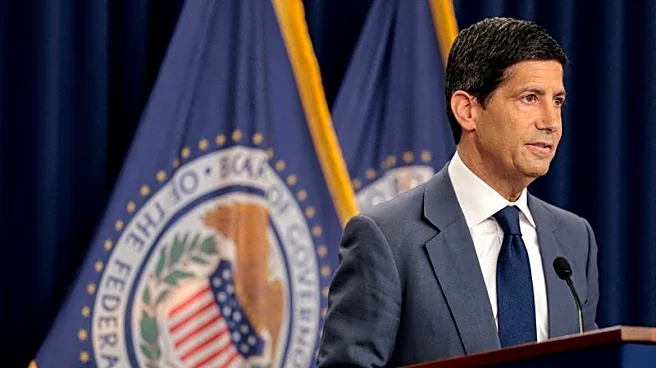
Federal Reserve chairman Kevin Warsh is urging the central bank to enhance its understanding of how artificial intelligence (AI) will reshape the U.S. economy. The rapid development of AI presents significant uncertainties regarding its long-term effects
on inflation, employment, and economic growth. Warsh recently revealed that the Fed is modeling various scenarios to assess AI's impact, ranging from increased productivity and economic growth to widespread job displacement and potential market corrections. While AI is already contributing significantly to economic growth, investment, and stock market gains, there is no consensus on the speed or extent of its transformative power. The Fed's semiannual financial stability report highlighted that 87% of respondents view AI-related risks, such as cyberattacks and disappointing earnings, as the top threat to the financial system. Warsh noted that while productivity gains have been 'reasonably strong,' they haven't yet shown a definitive, structural upward trend, and the inflationary impact of the data center buildout for AI is already being felt through increased demand for computer chips and other inputs.
Why It's Important?
The Federal Reserve's struggle to predict AI's economic impact is crucial because the central bank's monetary policy decisions directly influence the U.S. economy. Misjudging AI's effects could lead to inappropriate policy responses, potentially exacerbating inflation, unemployment, or financial instability. The potential for AI to either spur unprecedented growth or cause significant labor market disruption creates a complex challenge for policymakers. If AI leads to widespread job displacement, it could necessitate new social safety nets and retraining programs, impacting government spending and fiscal policy. Conversely, if AI drives substantial productivity gains, it could help mitigate inflationary pressures and foster a new era of prosperity. The uncertainty surrounding AI's trajectory also poses risks to financial markets, as investors weigh massive investments in the sector against the possibility of a 'bubble' and subsequent correction, affecting retirement savings and investment portfolios across the nation.
What's Next?
The Federal Reserve will continue to develop its understanding of AI's economic implications through ongoing research and scenario modeling. Chairman Warsh emphasized the importance of contingency planning to prepare for various outcomes, as the world changes rapidly due to AI. Policymakers will closely monitor key economic indicators, such as productivity growth, employment figures, and inflation rates, for signs of AI's influence. The Fed's future monetary policy decisions, including interest rate adjustments, will increasingly need to factor in the evolving impact of AI. Additionally, there may be growing calls for collaboration between the Fed, other government agencies, and industry experts to develop comprehensive strategies for managing AI's economic and societal consequences. The debate over potential regulatory frameworks for AI, especially concerning its financial implications, is also likely to intensify.
Beyond the Headlines
The Federal Reserve's grappling with AI's economic impact highlights a broader societal challenge: how to navigate a technological revolution with profound, yet unpredictable, consequences. Unlike previous industrial shifts, AI's unique ability to automate cognitive tasks introduces a new level of uncertainty regarding labor markets and economic structures. This situation forces a re-evaluation of traditional economic models and policy tools, as historical parallels may not adequately capture AI's transformative potential. The ethical dimensions of AI, such as data privacy, algorithmic bias, and the concentration of economic power, also loom large, potentially influencing public trust and regulatory responses. The U.S.'s ability to lead in AI development, as suggested by Warsh, is not just an economic imperative but also a geopolitical one, underscoring the technology's role in national competitiveness and global influence.