






What's Happening?
Filmmakers Naël Khleifi and Lisa Debauche, directors of 'Summer Meadow,' are challenging conventional narratives surrounding migration in cinema. Their film, which explores migration, exile, and the universal desire to discover the world against a pastoral
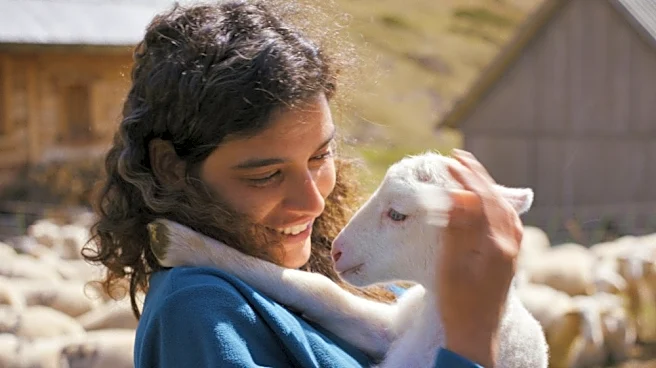
backdrop, was inspired by the observation that sheep could freely cross borders that humans could not. Khleifi, a Belgian-Palestinian filmmaker, and first-time director Debauche, aim to break down categories and boxes often used to define migrants. Khleifi criticizes Western cinema's portrayal of Black and Arab migrants, stating it's as though they are 'forbidden to dream,' and calls for confronting the 'hypocrisy' in such depictions. The film follows Hana, a Lebanese apprentice shepherdess seeking refuge in the French Alps, and blurs the lines between documentary and fiction to explore these themes.
Why It's Important?
The film 'Summer Meadow' is important because it seeks to reframe the discourse around migration, moving beyond simplistic portrayals often seen in mainstream media. By highlighting the personal journeys and dreams of migrants, the directors challenge audiences to consider the human element behind migration, rather than reducing individuals to mere statistics or political issues. Khleifi's critique of Western cinema's 'hypocrisy' in depicting Black and Arab migrants compared to European immigrants underscores a significant cultural and ethical concern within the film industry. This approach can foster greater empathy and understanding among viewers, potentially influencing public perception and policy discussions related to immigration. The film's blend of documentary and fiction also pushes artistic boundaries, suggesting new ways to tell complex human stories that resonate on a deeper, more personal level.
What's Next?
Following its award-winning run at Locarno and the Cairo Film Festival, 'Summer Meadow' screened at the Doha Film Festival in the Ajyal Feature Film Competition, judged by a youth jury. The film's continued presence at international festivals suggests it will reach a broader global audience, potentially sparking further discussions about migration narratives in cinema and society. The filmmakers' commitment to exploring the complexities of exile and the universal desire for discovery indicates a potential shift in how such stories are approached in the future. The film's impact could encourage other filmmakers to adopt more nuanced and human-centered approaches to depicting migrant experiences, moving away from stereotypical or politically charged portrayals. Its success may also inspire more collaborations between filmmakers and non-professional actors, enriching the authenticity of cinematic narratives.
Beyond the Headlines
The themes explored in 'Summer Meadow' extend beyond cinematic representation to touch upon profound societal issues such as identity, belonging, and the human right to dream. Khleifi's observation about the freedom of sheep versus the restrictions on human movement serves as a powerful metaphor for the arbitrary nature of borders and the inequalities inherent in global migration systems. The film's emphasis on breaking down categories and boxes for migrants speaks to a broader cultural imperative to recognize the individuality and richness of each person's story, rather than reducing them to collective labels. This artistic endeavor challenges viewers to reflect on their own biases and assumptions about migrants, fostering a more inclusive and empathetic understanding of diverse human experiences. The film's exploration of friendship and trust between characters from different backgrounds also highlights the potential for human connection to transcend cultural and societal divides.