





What's Happening?
China has released its national five-year plan for the new-type battery industry, setting ambitious targets for 2030. The plan, issued jointly by seven government bodies including the Ministry of Industry and Information Technology (MIIT), the National
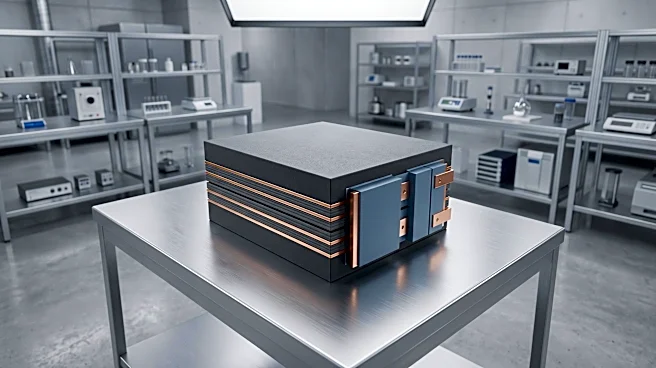
Development and Reform Commission, and the National Energy Administration, emphasizes the continued centrality of lithium-ion technology while explicitly promoting the parallel development of sodium-ion and flow batteries. Key objectives for 2030 include the preliminary large-scale application of all-solid-state batteries, achieving a cycle life of 15,000 cycles for long-life lithium batteries, and reducing product defect rates at leading manufacturers to parts-per-billion levels. The plan also calls for advancements in electrode materials, new electrolytes, and high-end auxiliary materials. Unlike previous industrial policies, this plan does not specify capacity or output-value targets, instead focusing on technological progress, quality improvement, and supply-demand discipline. The government aims to expand battery deployment across various sectors, including generation, grid, industrial parks, and data centers, to support China’s evolving power system.
Why It's Important?
This comprehensive battery development plan from China holds significant implications for the global energy storage market and the U.S. in particular. By prioritizing the development of next-generation chemistries like solid-state and sodium-ion batteries, China is positioning itself to potentially dominate future battery technologies, which could impact U.S. competitiveness in electric vehicles, renewable energy integration, and grid modernization. The emphasis on sodium-ion batteries, which are generally less energy-dense but potentially more cost-effective and safer for stationary storage, could offer a viable alternative to lithium-ion in certain applications, diversifying the global supply chain and potentially reducing reliance on lithium. For U.S. industries, this could mean increased competition, but also opportunities for collaboration or the need to accelerate domestic research and development in these emerging battery fields to maintain technological parity. The focus on quality and defect reduction also sets a high bar for manufacturing standards, which could influence global industry benchmarks.
What's Next?
The implementation of China's 2030 battery plan will likely lead to accelerated research and development in solid-state and sodium-ion battery technologies within China. This could result in new product introductions and increased market penetration of these advanced battery types in the coming years. The plan's call for tighter coordination between supply expansion and actual demand, along with strengthened capacity early-warning mechanisms and regulation of price competition, suggests a more controlled and strategic growth trajectory for China's battery industry. This could lead to more stable pricing and supply chains for certain battery components globally. U.S. policymakers and industry leaders will likely monitor these developments closely, potentially responding with their own initiatives to bolster domestic battery production and innovation, especially in areas where China is making significant strides. The focus on recycling and safety management also indicates a move towards more sustainable and secure battery ecosystems.
Beyond the Headlines
Beyond the immediate technological and economic implications, China's battery plan highlights a broader strategic shift towards securing leadership in critical clean energy technologies. By investing heavily in next-generation battery chemistries and manufacturing quality, China is not only aiming for energy independence but also seeking to establish itself as a global standard-setter. This could have long-term geopolitical ramifications, influencing trade relationships and technological alliances. The plan's emphasis on a multi-chemistry storage portfolio, rather than solely relying on lithium-ion, reflects a pragmatic approach to energy storage challenges, acknowledging the diverse needs of different applications. This diversified strategy could inspire other nations, including the U.S., to explore a wider range of battery technologies to enhance energy security and resilience. The ethical considerations around resource extraction and environmental impact, particularly for new battery chemistries, will also become increasingly prominent as these technologies scale up.