
What's Happening?
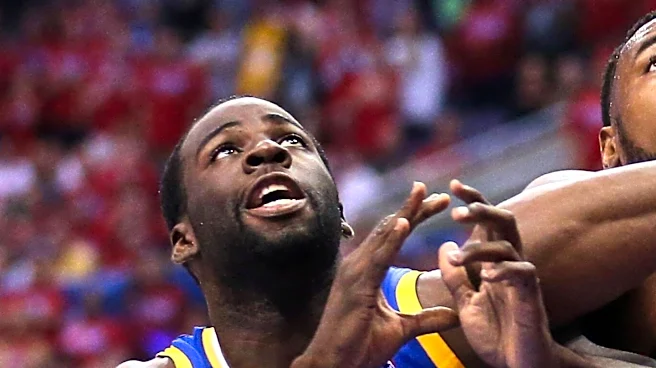
Draymond Green, on his podcast, addressed a question regarding which MVP season, between Derrick Rose's and Russell Westbrook's, was more impactful. Green stated that he does not believe either season was more important
than the other, emphasizing that the significance lies in the fact that both players achieved the MVP award. He highlighted that both guards became defining figures of their generation, known for their explosive athleticism and fearless attacking styles. Rose won his MVP in his third season at age 22, becoming the youngest ever to receive the award, while Westbrook earned his MVP six seasons later in 2016-2017 after Kevin Durant's departure from Oklahoma City. Green also expressed frustration with basketball fans' shifting opinions on Westbrook, noting that after years of criticism, fans are now praising his contributions following his retirement.
Why It's Important?
Green's refusal to differentiate the importance of Rose's and Westbrook's MVP seasons underscores a broader perspective on individual achievements in sports: the accomplishment itself holds inherent value, regardless of comparative metrics. This stance challenges the common tendency in sports discourse to constantly rank and compare, instead advocating for the recognition of unique greatness. For players, achieving an MVP title represents the pinnacle of individual performance, a testament to their skill and impact during a specific season. Green's comments also shed light on the often-harsh and fickle nature of sports fandom, where players can experience extreme criticism during their careers only to be lauded upon retirement. This dynamic can affect players' mental well-being and public perception, highlighting the need for a more nuanced appreciation of athletes' careers.
What's Next?
The discussion surrounding the legacies of Derrick Rose and Russell Westbrook will likely continue, particularly as both players' careers are now concluded. Green's perspective may encourage a more appreciative view of their individual achievements rather than constant comparison. For current players, this conversation might reinforce the idea that their accomplishments, especially major awards like MVP, are significant milestones that should be celebrated for their own merit. The broader sports media and fan base may continue to engage in debates about player impact, but Green's viewpoint offers a counter-narrative that values the shared experience of reaching elite status.
Beyond the Headlines
Green's commentary touches upon the subjective nature of 'impact' in sports. While statistics can quantify performance, the true impact of a player often extends beyond numbers, encompassing their influence on the game, their team, and the culture of basketball. Both Rose and Westbrook, through their unique styles and MVP seasons, left indelible marks on the NBA, inspiring a generation of players and fans. The frustration Green expressed regarding Westbrook's post-retirement praise after years of criticism also highlights the complex relationship between athletes and the public. It speaks to the pressure athletes face and the often-delayed recognition of their contributions, suggesting a need for more consistent appreciation throughout a player's career rather than just at its conclusion.