
What's Happening?
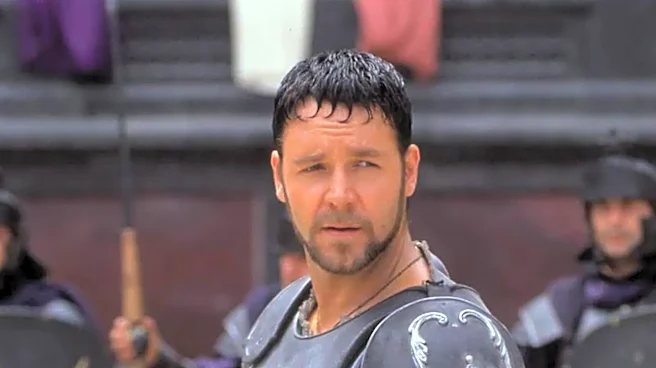
Russell Crowe, the Academy Award-winning actor, reportedly expressed significant dissatisfaction with the script for the 2000 epic historical drama 'Gladiator' during its production. Despite the film's
eventual critical and commercial success, including five Academy Awards, Crowe was vocal about his concerns regarding the dialogue and overall story. According to screenwriter William Nicholson, Crowe often described the script as 'garbage' but asserted his ability to make even poor lines sound compelling. This sentiment was echoed by a DreamWorks executive, who noted Crowe's attempts to rewrite the script on the fly, including his initial refusal to deliver the iconic line, 'I will have my vengeance, in this life or the next.' Crowe reportedly found many lines ridiculous and pompous, believing they did not fit the film's tone. The production of 'Gladiator' was characterized by numerous script changes and ongoing revisions, with multiple writers contributing to the screenplay even weeks before filming began.
Why It's Important?
This revelation highlights the often-turbulent creative process behind major Hollywood productions and the significant influence actors can wield. Crowe's insistence on improving the script, despite his initial disdain for parts of it, ultimately contributed to the film's enduring legacy and his own Oscar-winning performance. It underscores that a film's final success is not solely dependent on its initial script but also on the collaborative efforts and sometimes contentious input from its cast and crew. For the film industry, it illustrates the dynamic tension between writers, directors, and actors in shaping a narrative, and how overcoming such creative friction can lead to iconic cinematic moments. This behind-the-scenes insight also offers a deeper understanding of how 'Gladiator' transcended its initial script challenges to become a modern classic, influencing subsequent historical dramas and action films.
What's Next?
While 'Gladiator' is a completed work, the insights into its production process could influence future filmmaking approaches, particularly in how studios and directors manage creative disagreements with lead actors. The ongoing discussions about the film's legacy and its impact on the genre may lead to further retrospectives or documentaries exploring its challenging creation. For Russell Crowe, this information further solidifies his reputation as an actor deeply invested in the quality of his projects, potentially shaping perceptions of his future roles and directorial endeavors, such as his 2026 film 'What Love Builds.' The enduring popularity of 'Gladiator' may also prompt renewed interest in its production history, potentially leading to more detailed accounts from other cast and crew members about the script's evolution and Crowe's contributions.
Beyond the Headlines
The story of 'Gladiator's' script challenges and Russell Crowe's vocal criticisms delves into the complex interplay between artistic vision and commercial demands in Hollywood. It raises questions about authorship in filmmaking—who truly 'writes' a film when actors significantly alter dialogue or plot points. Ethically, it touches on the balance between an actor's right to interpret and refine their character versus adhering strictly to a writer's original intent. Culturally, 'Gladiator' became a touchstone for epic cinema, and knowing its imperfect origins adds a layer of appreciation for the final product, suggesting that great art can emerge from conflict and compromise. This narrative also highlights the often-unseen labor of script development, where multiple writers and revisions are common, underscoring that the final screenplay is often a mosaic of many contributions, not just a singular vision.