

What's Happening?
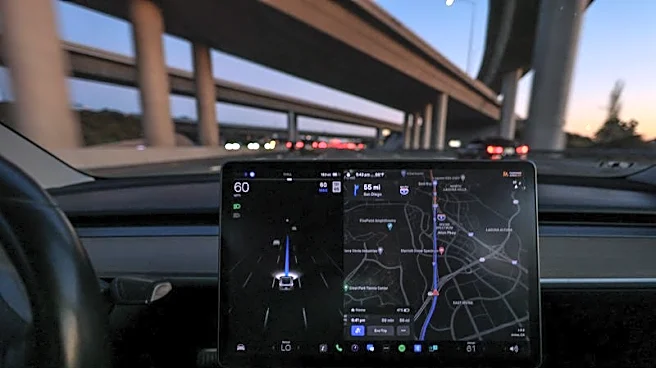
Tesla AI software chief Ashok Elluswamy announced on an October 21 earnings call that the company is developing its own mapping system. This new mapping capability is slated to be integrated into the upcoming Full Self-Driving (FSD) v15 software update.
The initial focus for v15 will be on improving the start and end points of trips, with further navigation and parking features to follow. Elluswamy also mentioned long-term plans for voice-activated route changes and a system that learns driver preferences. The FSD v15 update, which CEO Elon Musk described as a rewrite of Tesla's self-driving software with a larger AI model designed for AI4 (HW4) hardware, is expected to roll out widely in December. This update aims to address issues such as carpool lane usage, lane changes, and pothole avoidance, and will feature a significantly redesigned user interface that Musk claims will 're-render reality in a mind-bending way.'
Why It's Important?
The development of Tesla's proprietary maps and the FSD v15 update represent a significant step in the company's pursuit of autonomous driving. By building its own mapping system, Tesla aims to reduce reliance on third-party providers and potentially enhance the accuracy and responsiveness of its FSD technology. The planned improvements in navigation, parking, and collision avoidance could lead to a more seamless and safer driving experience for Tesla owners. The shift to a larger AI model and the requirement for AI4 hardware for optimal performance highlight the increasing computational demands of advanced autonomous systems, potentially creating a divide between newer and older Tesla vehicles. This could influence consumer purchasing decisions and accelerate the adoption of newer hardware, impacting the automotive technology market.
What's Next?
Tesla is targeting a wide release of FSD v15 in December, potentially coinciding with its holiday update. While the exact rollout schedule for the U.S. and Canada has not been specified, owners with AI4 (HW4) hardware are expected to be the primary beneficiaries. Owners of older HW3 cars who purchased Full Self-Driving are still awaiting hardware upgrades, with CEO Elon Musk having previously outlined options for a discounted trade-in or a computer upgrade. Tesla has not yet provided a date for these retrofits, and a 'v15 Lite' build for HW3 cars seems unlikely due to hardware limitations. Looking further ahead, Ashok Elluswamy indicated that Tesla aims for some customer cars to join its driverless Robotaxi fleet around the second quarter of 2027, a separate milestone from the December software rollout.
Beyond the Headlines
The continuous evolution of Tesla's FSD technology, particularly with the introduction of proprietary maps and a more advanced AI model, raises broader questions about the future of transportation and urban infrastructure. The ability for vehicles to learn preferred routes and respond to voice commands could fundamentally alter how individuals interact with their cars and navigate their environments. The ambition to integrate customer cars into a Robotaxi fleet by 2027 suggests a future where personal vehicles could also serve as income-generating assets, potentially disrupting traditional ride-sharing and taxi services. However, the ongoing challenges with hardware compatibility and the need for drivers to remain attentive with FSD (Supervised) underscore the complex ethical and regulatory considerations that accompany the advancement of autonomous driving technology.