

What's Happening?
Airbus is significantly expanding its production capacity for the A320neo family aircraft, aiming to reach a monthly production rate of 75 by the end of 2027. This expansion is driven by a substantial backlog of 9,310 commercial aircraft orders, with
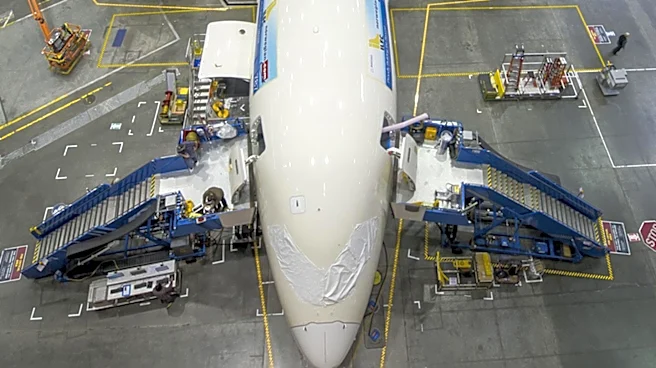
the A320neo family accounting for the majority, particularly the A321neo variants. To support this, Airbus recently opened a second A320neo final assembly line in Toulouse. Concurrently, the French government is preparing to allocate €350 million in 2026 to the Conseil pour la recherche aéronautique civile (Corac), an organization that coordinates research projects within the French aerospace industry. This funding is intended to support the development of technologies for a successor to the A320neo, which Airbus CEO Guillaume Faury anticipates launching around 2030, with entry into service expected later in the following decade. The company faces the dual challenge of fulfilling existing orders while also innovating for future aircraft generations.
Why It's Important?
This development is crucial for the global aerospace industry, particularly for the U.S. market, as Airbus is a major competitor to U.S.-based Boeing. Increased production capacity by Airbus could intensify competition for aircraft orders from U.S. airlines and leasing companies. The substantial investment in a successor to the A320neo family signals Airbus's long-term strategic vision and commitment to maintaining its market leadership in the single-aisle aircraft segment. This could pressure U.S. manufacturers to accelerate their own research and development into next-generation aircraft, potentially leading to advancements in fuel efficiency, reduced emissions, and new aviation technologies. The French government's financial support highlights the strategic importance of the aerospace sector to national economies and could influence similar government-backed initiatives in other countries, including the U.S., to support their domestic aerospace industries.
What's Next?
Airbus is expected to continue its ramp-up of A320neo family production, targeting the 75 aircraft per month rate by 2027. The French government's €350 million funding for Corac in 2026 will likely kickstart or significantly advance research and development efforts for the A320neo successor. This will involve collaboration between Airbus, its suppliers, and smaller companies within the French aerospace industry. Over the next few years, more details about the technological specifications and design concepts for the new aircraft are anticipated. The launch of the successor aircraft is projected around 2030, with its entry into service expected in the subsequent decade. This timeline suggests that the aerospace industry will see significant innovation and competition in the single-aisle market segment in the coming years, with potential implications for global airline fleets and manufacturing strategies.
Beyond the Headlines
The dual focus on increasing current production and investing in future aircraft technology reflects a broader trend in the aerospace industry: the need to balance immediate market demands with long-term sustainability and innovation. The development of a successor to the A320neo family will likely incorporate advanced materials, propulsion systems, and digital technologies aimed at improving fuel efficiency and reducing environmental impact, aligning with global climate goals. This strategic move by Airbus, backed by government funding, could set new benchmarks for aircraft design and manufacturing, influencing regulatory standards and operational practices worldwide. It also underscores the critical role of government support in fostering innovation and maintaining competitiveness in high-tech industries, potentially leading to debates about industrial policy and international trade dynamics in the aerospace sector.