






What's Happening?
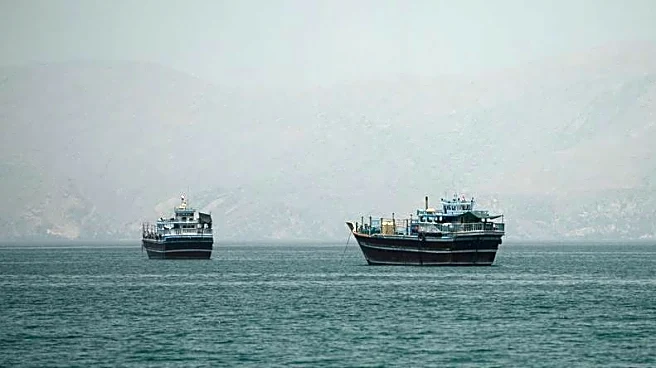
Oil prices have decreased as more stranded oil tankers have exited the Strait of Hormuz, despite a cargo vessel being hit near Oman. Brent crude futures fell by 0.25% to $75.07 a barrel, while U.S. West Texas Intermediate dropped by 0.18% to $71.79 a barrel.
The incident near Oman involved a cargo vessel being hit by an unknown projectile, leading to the suspension of a U.N. voluntary evacuation scheme. U.S. officials have indicated that Iran fired on the ship as it attempted to pass through the strait. This geopolitical tension has introduced a risk premium into oil prices, with markets closely monitoring tanker traffic and potential impacts on production plans. Despite these tensions, crude shipments through the Strait of Hormuz have risen to their highest level since a ceasefire deal reopened the waterway, although overall traffic remains below pre-conflict levels.
Why It's Important?
The decline in oil prices amid geopolitical tensions in the Strait of Hormuz has significant implications for global energy markets. The strait is a critical chokepoint for oil transportation, and disruptions can lead to volatility in oil prices, affecting global supply chains and economic stability. The incident near Oman highlights ongoing security concerns in the region, which could impact future oil production and transportation. For the U.S., changes in oil prices can influence domestic energy costs, consumer prices, and economic growth. Additionally, the situation underscores the geopolitical complexities in the Middle East, which can have broader implications for international relations and energy policies.