



What's Happening?
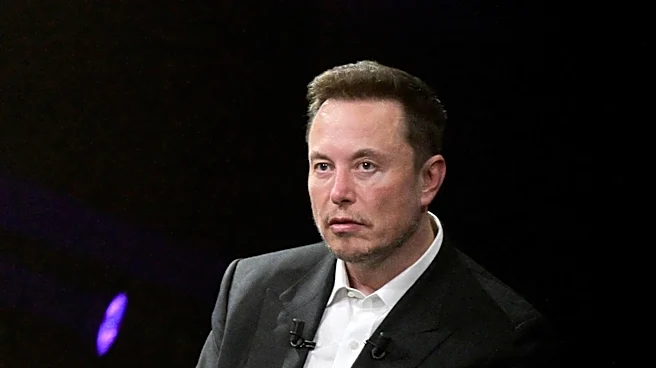
Elon Musk, owner of X and head of SpaceX's AI unit, has reportedly expressed concerns regarding the performance of his generative AI chatbot, Grok. According to The New York Times, Musk informed employees that Grok is "falling behind in A.I. development."
This sentiment was reportedly shared in a group chat with hundreds of engineers, where Musk allegedly presented data indicating the company's lag compared to competitors. The report suggests Musk is contemplating a strategic shift towards selling compute resources, potentially putting him in direct competition with major tech companies like Oracle, Meta, Google, and Amazon. This comes despite Musk's public promotion of Grok and Grok Bot on X, where he encouraged users to engage with the AI. The cost of running Grok has also been a factor, with users reporting throttled usage limits in early November, which Musk attributed to the "unsustainably high" cost of serving Grok Bot relative to revenue.
Why It's Important?
This reported shift in strategy by Elon Musk could have significant implications for the competitive landscape of the artificial intelligence and cloud computing sectors. If SpaceX's AI unit pivots to selling compute, it would introduce a new, well-resourced player into an already competitive market, potentially driving down prices or increasing innovation in compute services. For the AI industry, Musk's reported acknowledgment of Grok "falling behind" highlights the intense and rapidly evolving nature of AI development, where even well-funded projects can struggle to maintain a leading edge. This could also signal a re-evaluation of the viability of developing proprietary large language models versus leveraging existing infrastructure or focusing on other AI applications. Companies like OpenAI and Anthropic, which are at the forefront of AI development, could face increased pressure or new opportunities depending on Musk's ultimate decision. The financial strain of running Grok also underscores the substantial investment and operational costs associated with developing and deploying advanced AI models, a critical consideration for any company entering or expanding in this space.
What's Next?
Musk is reportedly faced with two primary options: either abandon Grok entirely and reallocate resources to selling compute, or continue to manage both Grok's development and the compute sales, while competing with established AI labs and open-weight models. The decision will likely influence the future direction of SpaceX's AI unit and its role in the broader tech ecosystem. If Musk opts to prioritize selling compute, it could lead to significant investments in data center infrastructure and a more direct challenge to cloud service providers. Conversely, if he continues to pursue Grok's development, it will necessitate a renewed focus on innovation and efficiency to catch up with competitors and manage operational costs. The reported internal discussions and potential strategic pivot suggest that a definitive announcement or observable shift in operations could occur in the near future, impacting both the AI and cloud computing markets.
Beyond the Headlines
The reported internal struggles with Grok's development and the consideration of selling compute resources touch upon deeper themes within the technology industry, particularly the challenges of rapid innovation and the economics of AI. The high cost of running advanced AI models, as acknowledged by Musk, highlights the significant financial barriers to entry and sustained operation in the AI space. This could lead to a consolidation of AI development among a few highly capitalized entities or a greater reliance on shared compute infrastructure. Furthermore, the narrative of a prominent tech leader like Musk reportedly questioning the competitiveness of his own AI product could influence investor confidence and public perception of the AI market's maturity and future trajectory. It also underscores the ethical and strategic dilemmas faced by companies in allocating vast resources to projects that may not yield immediate or superior results, prompting questions about sustainable business models for frontier AI development.